Most Indian Parents Get This Wrong.
Every month, parents call us about their child in Grade 11. The board exams are coming. The pressure is enormous. And then, almost always, comes the same question: “Is it too late to start career counselling now?”
The honest answer is: not entirely. We can still help. But the window in which we can do the most meaningful, life-shaping work – that window opened in Grade 7 or 8. For many families, it has already begun to close.
This is not meant to alarm you. It’s meant to reframe a question that most Indian parents are asking at exactly the wrong stage. The question isn’t what career should my child choose. The deeper, more important question is: when should we start helping them figure that out?
The research on this is clear. The developmental science is clear. And yet, as a country, we almost universally get the timing wrong.
What’s Actually Happening Between Grade 7 and Grade 10
Between the ages of 12 and 16, your child isn’t just studying. They are doing something far more consequential – they are forming their identity. They are answering, without realising it, a question no one is asking them out loud: Who am I? And what am I capable of?
The answers they arrive at during these years – about their own intelligence, their strengths, their place in the world – tend to stick. What a child concludes about themselves at 13 or 14, they carry into their stream selection at 15, their college applications at 17, and often, their entire early career.
| Grade | What the Child Is Actually Doing | What Parents Assume |
|---|---|---|
| Grade 7 | Comparing themselves to peers. Forming first beliefs about their own ability. Testing what they’re good at. | “Too early to worry about direction.” |
| Grade 8 | Peer influence at its peak. Imitating what friends choose. Quietly giving up on interests that feel unsafe. | “They seem fine. Let them enjoy this time.” |
| Grade 9 | Social comparison intensifying. Choosing what feels safe over what actually fits. Self-confidence quietly shifting. | “Focus on academics. It’s a foundation year.” |
| Grade 10 | Stream selection looming. Most children choosing based on peers or parental expectation — not on what fits them. | “Now we need to think seriously about their future.” |
| Grade 11-12 | Locked into a stream. Many struggling with subjects that don’t connect. Self-esteem quietly declining. | “This is just exam pressure. It’s normal.” |
Notice the gap between what the child is actually going through and what parents perceive. The years parents treat as a waiting room – grades 7, 8, 9 – are precisely the years when the child’s inner world is most actively being shaped. And shaped, in most cases, without any structured guidance.
| “The child doesn’t lose confidence suddenly in Grade 11. They lose it slowly, over three years of making choices without understanding themselves – and then blaming themselves when those choices don’t fit.” – Prabha Rajan, Elysian Inspires |
The Numbers Are Hard to Ignore
This isn’t just a pattern Elysian Inspires sees in sessions. It’s documented across the Indian education system.
And perhaps the most striking finding: only 6% of students felt they had chosen their stream correctly. 42% chose based on parental influence. 28% chose because of what their friends were doing. This is what happens when stream selection is treated as something that doesn’t require professional guidance.
The Three Windows – And Why They’re Not Equal
One of the most important things to understand about career guidance is that what’s possible at each stage is fundamentally different. The earlier the engagement, the wider the range of possibilities.
Full Range of Possibilities Open
The most powerful stage – and the most underutilised in India. Identity is still forming. Interests are real but not yet locked. Beliefs about capability are still malleable. A child at this stage can be guided toward what they’re genuinely built for, without fighting years of accumulated self-doubt or peer-driven decisions.
Most Pathways Still Open – With Some Course Correction
Still a strong stage for intervention. Most meaningful pathways remain open. However, the child has spent 2-3 years forming beliefs without guidance, and some of those beliefs will need to be examined before direction-setting can begin. Stream selection is imminent – this is the last meaningful point to influence it.
Working Within What’s Already Been Decided
The stream is chosen. Career guidance at this stage is valuable – but it operates within a narrower space. Many doors that were open at Grade 7 now require significantly more effort to reopen. The work here shifts from direction-setting to damage control, confidence rebuilding, and finding the best available path within constraints that are already in place.
Grade 11 career counselling is reactive. Grade 7 career counselling is generative. Both matter – but they are not the same thing.
A Story You May Recognise
There was a student – let’s call her Riya – who came to us in Grade 11. Bright kid. Genuinely bright. The kind of child who had a question for everything at twelve. Curious, creative, full of ideas.
By fifteen, she had stopped asking questions. By seventeen, she had stopped believing she had anything worth asking about.
She was sitting across from us, staring at Physics. Trying to clear a paper in a subject that was never meant for her. Not angry, not dramatic – just tired. “I study every day,” she said. “I don’t understand why it’s not working.”
When we asked what she actually loved, her eyes lit up for the first time that session. She loved people. Conversations. Understanding what made someone tick. She would have been extraordinary in counselling, communication, psychology – a dozen fields that need exactly the kind of mind she had.
Nobody saw that at thirteen. And by seventeen – even she had stopped seeing it.
Why the Right Question Is “Who Is My Child?” – Not “What Career?”
The most common mistake in career guidance – at any stage – is beginning with the wrong question. Parents want to know: what should my child become? Children are asked: what do you want to do after Class 12?
Both questions are premature. You cannot meaningfully answer them without first understanding who the child actually is – how they think, how they learn, what environments bring out their best, and what kind of intelligence is naturally dominant in them.
This is what structured career assessment does. At Elysian Inspires, every engagement begins with understanding before direction. Through tools like the DMIT Assessment, we build a detailed portrait of who the child actually is – independent of what their teachers think, what their peers are choosing, or what their parents hope for.
| What the DMIT Assessment Reveals: Dominant intelligence type across 8 categories (linguistic, logical, spatial, musical, kinesthetic, interpersonal, intrapersonal, naturalistic) · Brain dominance (analytical vs. creative) · Learning style (visual, auditory, kinesthetic) · Personality orientation · Natural working style. The result is not a test to pass or fail – it’s an accurate, stable portrait of who the child is built to be. |
The 10,000-Hour Argument: Why Direction Matters Now
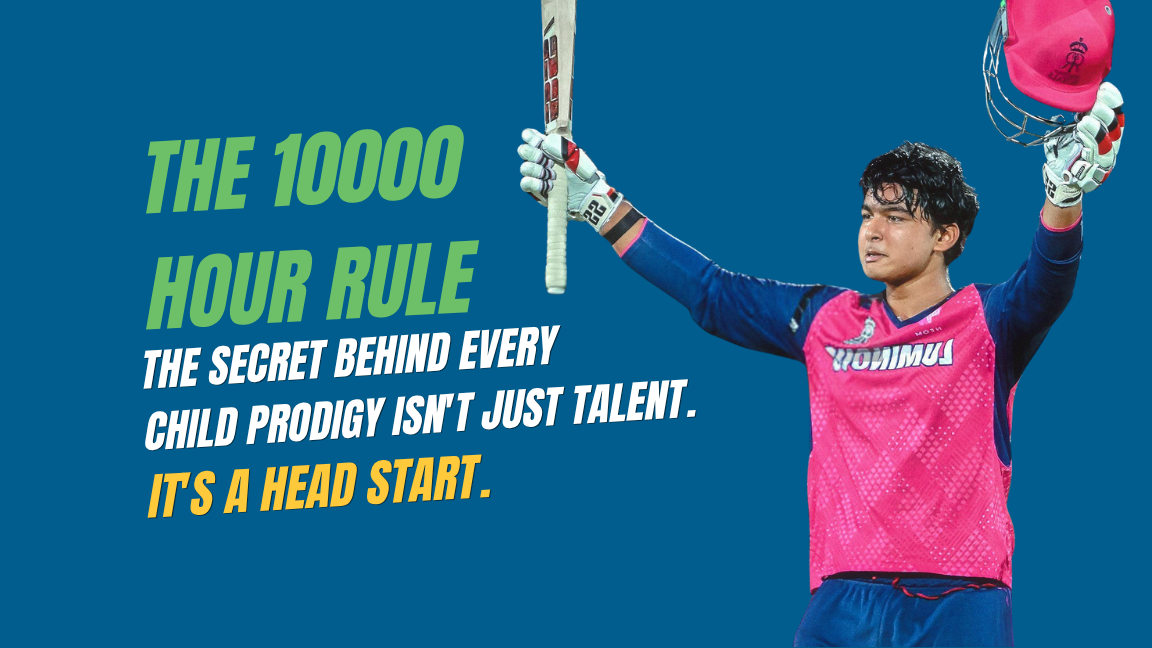
There’s a principle in expertise research – popularised by Malcolm Gladwell, grounded in Anders Ericsson’s work – that world-class performance in any domain requires approximately 10,000 hours of deliberate, focused practice. At three focused hours per day, that’s roughly nine years.
A child who begins purposeful, direction-aligned work at age 13 reaches mastery-level capability by age 22 – well-positioned at the start of their career. A child who only finds their direction at 22 reaches the same point at 31. That’s not just a delay. That’s a fundamentally different life trajectory.
| “Vaibhav Suryavanshi didn’t become extraordinary at 15. He started becoming extraordinary at 6 – when his direction was identified and his hours began to count toward something specific.” – On the 10,000-Hour Principle |
Career guidance is not just about helping a child pick a subject. At the right stage, it’s about pointing the 10,000 hours in a direction worth travelling. And that decision is most powerful when it’s made at 12 or 13, not at 17 or 18.
What the Right Guidance Looks Like at Each Stage
If your child is currently between Grade 7 and Grade 12, here is what structured career counselling looks like at each stage – and what remains possible.
| Stage | What Guidance Covers |
|---|---|
Grade 7-8 Ideal Window |
|
Grade 9-10 Good Window |
|
Grade 11-12 Constrained Window |
|
What to Do If Your Child Is in Grade 7, 8, or 9 Right Now
If your child is in any of these grades – or heading into them – the single most useful thing you can do is start the conversation now. Not in Grade 11 when the stream is already locked. Not in Grade 10 when stream selection is three months away. Now, while the identity is still forming and the possibilities are still wide open.
This doesn’t mean placing pressure on a child who isn’t ready for it. Structured career guidance at this stage isn’t about forcing decisions. It’s about giving a child a clear, accurate picture of who they are – so that when the decisions come, they make them from a place of self-knowledge rather than anxiety or imitation.
The question that changes everything isn’t what career should my child choose. It’s who is my child – and what are they truly built for? That question, asked at the right time and answered with the right tools, is one of the most powerful things a parent can do.
The window is still open. The 10,000 hours are still counting.