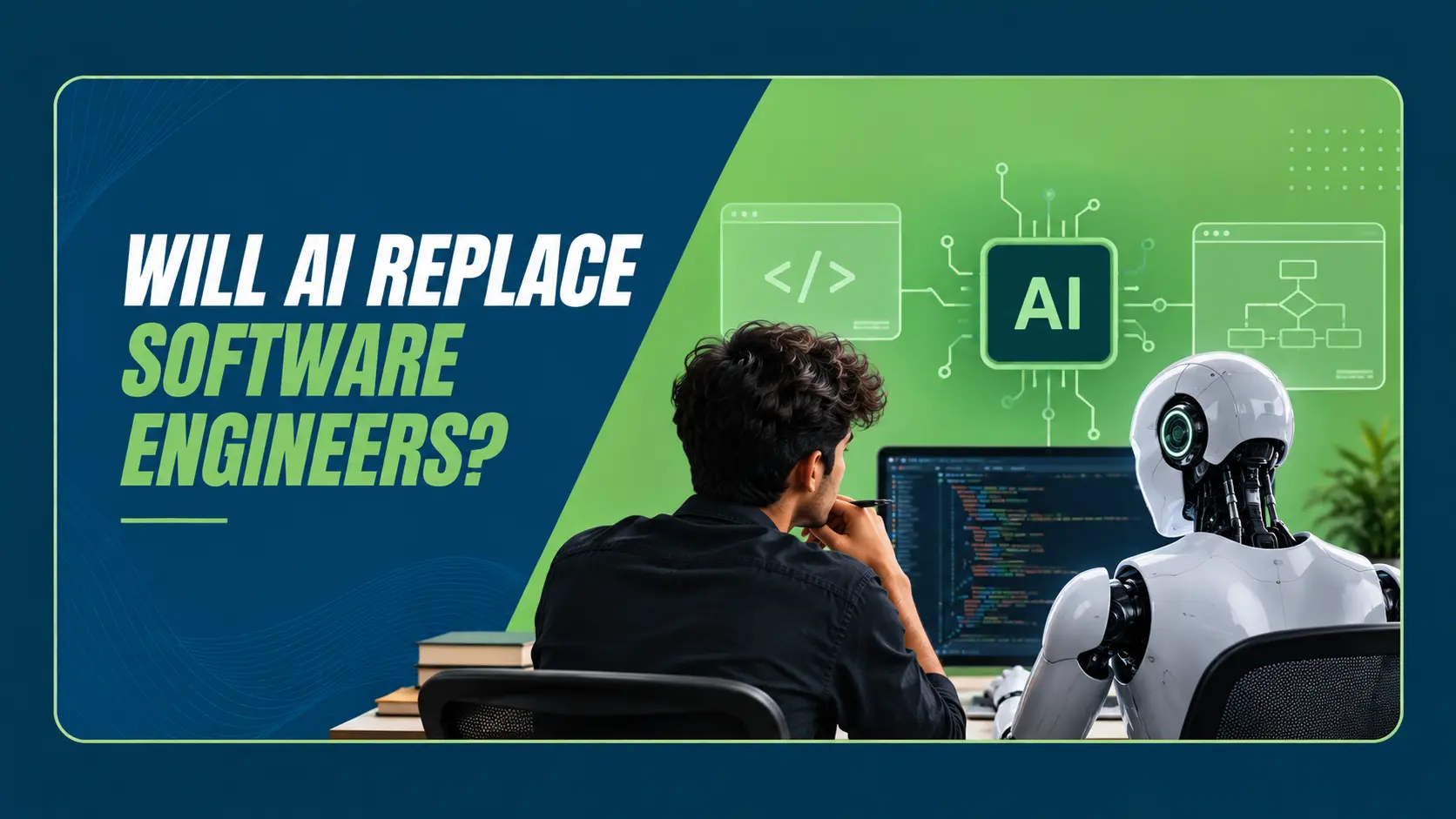
Will AI Replace Software Engineers? An Honest Look at the Future of Software Engineering
If AI can now write code, is a B.Tech in CSE still worth it? We looked at the latest research, hiring data from India, and what companies are actually paying for. Here’s the honest answer.
Every parent of a Class 11 or 12 student has heard some version of this in the last year: “AI can build apps now. Why would anyone hire a software engineer?” And every engineering student has quietly wondered whether they picked the wrong course.
So, will AI replace software engineers? We didn’t want to give you either the panic version or the “don’t worry, everything’s fine” version. Both are wrong. Here is what the data actually shows about the future of software engineering, and what students should do about it now.
No, AI is not replacing software engineering as a profession. Overall demand for people who build software is still expected to grow. But AI is clearly replacing a certain kind of software engineer: the fresher whose only skill is writing routine code from instructions. Entry-level jobs are shrinking, and what companies expect from a new graduate has changed. The career has a future. The old way of entering it does not.
Will AI Replace Software Engineers? What the Data Actually Says
The research points in two directions at once, and both are true.
The worrying part: entry-level jobs are shrinking
Stanford’s 2026 AI Index, drawing on payroll records of millions of US workers, found that employment for software developers aged 22 to 25 has fallen by nearly 20% since late 2022. In the same firms, employment for older, more experienced developers grew. The decline lines up with the period when generative AI tools went mainstream.
This matters because ages 22 to 25 are exactly the first few years after a B.Tech. The tasks juniors used to learn on, such as small bug fixes, simple features, and writing tests, are the tasks AI handles best.
The reassuring part: overall demand is still growing
The US Bureau of Labor Statistics, which now factors AI into its forecasts, still projects software developer jobs to grow by 15.8% between 2024 and 2034, adding about 267,700 jobs. That’s the largest increase of any computer-related occupation it tracks. The World Economic Forum’s Future of Jobs Report 2025 also lists software and applications developers among the fastest-growing jobs globally through 2030, alongside AI specialists, big data and cybersecurity roles.
The part most people miss: AI still needs supervising
In Stack Overflow’s 2025 survey of about 49,000 developers, 84% said they use or plan to use AI tools, but only 29% trusted the output to be accurate, down from 40% the year before. The most common complaint: AI answers that are almost right, but not quite.
A controlled study by the research group METR found something even more surprising. Experienced developers working on large, familiar codebases were 19% slower when using AI tools, even though they believed they were faster. AI speeds up simple, well-defined work. Complex, messy, real-world systems still need people who understand them deeply.
The Future of Software Engineering in India Right Now
India’s picture follows the same pattern, with some local twists.
- The industry is still growing, just slower. Nasscom projects India’s tech industry revenue at $315 billion for FY26, with about 135,000 net new jobs and total headcount close to 6 million.
- Mass fresher hiring has cooled. In early 2026, India’s four largest IT services firms barely grew their headcount, and TCS’s workforce actually shrank by about 11,000 in a single quarter, as companies leaned harder on AI.
- But AI-skilled freshers are being paid more. Infosys has started offering up to ₹21 lakh a year to freshers with advanced AI skills, and other IT firms are raising entry-level pay for the same profile.
- New roles are appearing. TCS is hiring “Forward Deployed Engineers” who build AI solutions directly with clients, and Infosys plans to train around 6,000 of them.
- Skills are starting to matter more than degrees. In a 2026 Indeed–Nasscom report, 86% of employers said AI had already changed job roles, and 40% said they prefer demonstrable AI skills or certifications over degrees.
Put simply: the ₹3.5 lakh “mass recruiter” job that absorbed lakhs of average engineering graduates every year is the part under real pressure. The high-skill end of the market is getting more rewarding.
What AI Can and Can’t Do in Software Engineering
| Task | How well AI handles it today | What this means for engineers |
|---|---|---|
| Writing routine code from clear instructions | Very well, and fast | Less value in being “just a coder” |
| Building a quick prototype or simple app | Well, often in hours | Ideas get tested faster; more software gets built overall |
| Debugging large, complex systems | Inconsistent; often “almost right” | Deep understanding is still essential |
| Deciding what to build and why | Poorly; it needs a human to define the problem | Product sense and business understanding grow in value |
| Security, reliability, accountability | Needs human review and ownership | Someone must still sign off and be responsible |
| Talking to clients and translating needs | Can’t replace trust and judgement | Communication becomes a core engineering skill |
Software Engineering Roles: What’s Shrinking, What’s Growing
Under pressure
- Routine coding and simple website/app builds
- Manual testing
- L1/L2 IT support and maintenance
- Roles where the job is “convert instructions into code”
Growing
- AI and machine learning engineering
- Cloud, data engineering and big data
- Cybersecurity
- Product-minded engineers and client-facing AI roles
- Domain + tech (fintech, healthtech, edtech)
Is Software Engineering Still a Good Career After 12th?
Yes, for the right student. This is the part most “scope” articles skip. AI hasn’t made software engineering a bad career. It has made it a bad default career.
Software engineering is a strong choice if your child:
- Enjoys solving problems and figuring out why something doesn’t work
- Builds things on their own: small apps, games, websites, automations, even without being asked
- Is curious about how businesses, people or systems work, not just about code
- Is willing to keep learning for their whole career, because the tools will keep changing
It’s a risky choice if:
- CSE is being chosen because “everyone is doing it” or because of the salary alone
- The plan is to clear an exam, get a degree, and wait for campus placement
- The student doesn’t actually enjoy logical, detail-heavy work
How to Adapt Now: A Practical Plan
If you’re in Class 11 or 12
- Test the interest before the entrance exam. Spend a few weekends building something small: a website, a simple game, a bot. If you enjoy it even when it’s frustrating, that’s a strong signal.
- Look beyond “CSE vs everything else.” Data science, AI, electronics, design, and domain-heavy fields like fintech or biotech all combine tech with something AI can’t easily replace.
- Strengthen maths and logical reasoning. These matter more, not less, when AI writes the routine code.
If you’re in college now
- Learn the fundamentals deeply. Data structures, system design, databases and how the internet works. You can’t supervise AI’s code if you don’t understand what good code looks like.
- Use AI tools daily, but check everything. Learn to review, test and fix what AI produces. That is the new junior skill.
- Build real projects with real users. A deployed project that people actually use beats ten certificates. Employers increasingly want proof, not just marks.
- Pick a direction by third year. AI/ML, cloud, security, data, or a domain like finance or healthcare. Generalist freshers are the ones getting squeezed.
- Practise communication. Explaining a technical idea to a non-technical person is fast becoming an engineering skill, not a soft skill.
If you’re already working as a software engineer
- Move up from “writing code” to “owning outcomes.” Architecture, reliability, and understanding the business problem are where experienced engineers are gaining value.
- Get hands-on with AI engineering. Building with AI models, agents and APIs is the fastest-growing skill area in the industry.
- If you feel stuck, plan the shift deliberately. A move into product, data or AI roles works best with a clear plan rather than a panic switch.
The Bottom Line
AI won’t end software engineering. It’s ending the version of software engineering where a degree alone guaranteed a job. The engineers who will do well over the next decade are the ones who understand problems deeply, use AI as a powerful tool rather than fear it, and keep learning. For students, that starts with an honest question: is this really the right field for me?
Frequently Asked Questions
Will AI replace software engineers completely?
Current evidence says no. Overall demand for software developers is still projected to grow, but entry-level roles focused on routine coding are shrinking. The job is changing from writing code to designing, supervising and owning software.
Is B.Tech CSE still worth it in 2026?
It’s worth it for students with genuine interest and aptitude who are willing to build real skills beyond the syllabus. It’s a risky choice if picked only for salary or because peers are choosing it.
What is the future of software engineering in India?
India’s tech industry is still growing, but mass fresher hiring has slowed. Companies are paying more for freshers with AI, cloud and data skills, and new roles like Forward Deployed Engineers are emerging.
Which software engineering skills will be in demand?
AI and machine learning engineering, cloud and data, cybersecurity, system design, and the ability to work with AI tools while checking their output. Communication and problem-framing are increasingly important too.
Should my child choose AI/Data Science instead of CSE?
It depends on their aptitude. AI and data roles lean more on maths and statistics; core CSE leans on systems and building. A structured aptitude assessment can show which path fits better before you commit.
Sources: Stanford HAI AI Index 2026 and Stanford Digital Economy Lab; US Bureau of Labor Statistics, Employment Projections 2024–34; World Economic Forum, Future of Jobs Report 2025; Stack Overflow Developer Survey 2025; METR (2025), Measuring the Impact of Early-2025 AI on Experienced Open-Source Developer Productivity; Nasscom FY26 industry estimates; Indeed–Nasscom report, India’s AI Talent Inflection Point (2026); The Register (January 2026); The Hans India (2026).
Choosing between CSE, AI, Data Science or something else?
Don’t decide on hype or fear. Elysian Inspires has guided 5,000+ students to pick a course that fits their aptitude, not the crowd. Talk to Ms. Prabha before you lock in a stream or college.
Talk to an Expert Call +91 72999 32010