
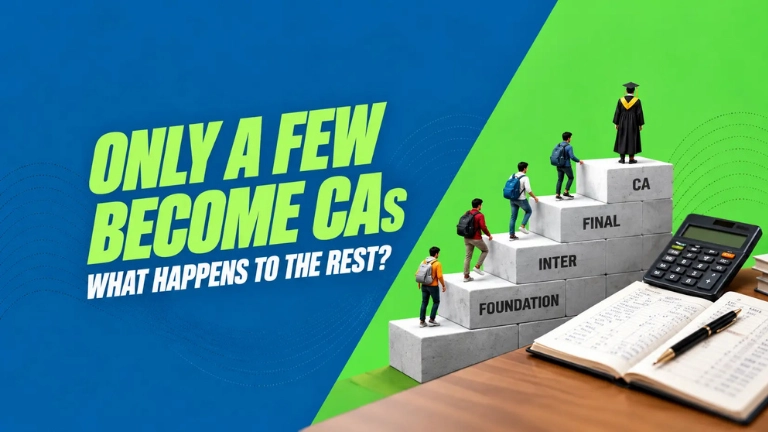
CA Pass Percentage 2026: What Happens to the Students Who Don’t Make It?
CA is a respected, rewarding qualification. But most students who start it don’t finish. Before your child commits 4 to 7 years, here is the honest data, six alternatives, and a simple checklist to decide.
Every year, lakhs of Commerce students in India begin the CA journey. Many of them are pushed into it with the best intentions: “CA is safe. CA is respected. CA earns well.” All of that is true for the students who become CAs. This blog is about everyone else.
We’re not here to put CA down. We’re here to help parents and students make the decision with open eyes: look at the real CA pass percentage, understand what happens to the students who don’t clear, and compare CA honestly with other accounting and finance qualifications that can lead to an equally good career.
CA Pass Percentage 2026: The Real Numbers
These are the latest official results declared by ICAI (the Institute of Chartered Accountants of India) for the May 2026 exams.
| CA level (May 2026) | Appeared | Passed | Pass % |
|---|---|---|---|
| Foundation | 90,217 | 18,124 | 20.09% |
| Intermediate (both groups) | 33,304 | 2,820 | 8.47% |
| Intermediate Group I only | 91,237 | 9,350 | 10.25% |
| Final (both groups) | 23,776 | 3,345 | 14.07% |
| Final Group I only | 54,606 | 6,555 | 12.00% |
This isn’t a one-off bad year. CA Foundation pass rates have stayed below 25% in each of the last five sessions. At CA Final, the both-groups pass rate actually fell from 18.75% in May 2025 to 14.07% in May 2026.
What the CA Pass Percentage Really Means
A pass rate of 20% doesn’t mean 20% of students eventually become CAs. Students write these exams several times, and every level is a separate filter: Foundation, then Intermediate, then articleship, then Final.
ICAI doesn’t publish how many students who start CA eventually finish it, so no one can give you an exact figure. But the direction is clear. With roughly one in five clearing Foundation in a sitting, and around one in ten clearing Intermediate’s both groups in a sitting, the large majority of students who begin CA never complete it. Many of them only stop after three, four or five years of attempts.
What Happens to the Students Who Don’t Clear CA?
The students who stop after several attempts aren’t “failures.” Most of them are hardworking, capable people. But they often face a hard few years:
- Lost time. Friends from school have graduated, started working, or finished a master’s degree, while they are still preparing for the next attempt.
- A thin CV. Some students pause their degree or treat it as an afterthought, so when they leave CA, they have neither the qualification nor a strong degree.
- Confidence damage. Repeated results of “not cleared” can make a talented student feel they’re not good enough, which follows them into interviews and jobs.
- Family pressure. Parents who’ve invested heavily in coaching often want “one more attempt,” which can stretch a 4-year plan into 7 or 8 years.
The good news: CA preparation is never wasted. The accounting, tax and audit knowledge transfers directly to other qualifications. ACCA, for example, offers paper exemptions to students who’ve cleared CA levels, so a CA student switching paths isn’t starting from zero.
Did the Parents Make a Mistake?
Usually, no. Parents push CA because they’ve seen it work: steady jobs, respect, good salaries. ICAI’s 2026 campus placement reported an average starting package of ₹12 to 13 lakh a year for newly qualified CAs, with more vacancies than candidates.
The mistake isn’t choosing CA. The mistake is choosing CA as the only option, without checking whether the child’s aptitude, working style and goals fit it, and without a plan B. A student who would thrive in investment analysis, global finance roles or management accounting may struggle in CA’s exam-heavy, India-law-heavy format, and wrongly conclude they’re “not good at commerce.”
Is CA the Only Way to a Good Commerce Career? No.
India’s finance job market has changed. Multinational companies and Global Capability Centres (GCCs) in Chennai, Bengaluru, Hyderabad and Pune hire heavily for global accounting, reporting and financial analysis roles. For many of these roles, international qualifications are valued as much as, or more than, CA.
About global recognition, to be fair: CA is respected abroad, and ICAI has mutual recognition agreements with six bodies, including CPA Australia and Chartered Accountants Australia and New Zealand. But those agreements still require extra exams and don’t include audit or practising rights overseas. Qualifications like ACCA, US CPA and US CMA are built to be global from day one.
7 Options to Compare Before Choosing CA
1. CA (ICAI)
India’s gold standard for audit, taxation and statutory compliance. Best if your child wants to practise, sign audits, or work deep in Indian tax and law.
2. ACCA (UK)
Global accounting qualification with flexible, paper-by-paper exams. Strong for MNCs, Big 4 global delivery centres and working abroad.
3. CMA (ICMAI, India)
Focused on cost and management accounting. Good for manufacturing, costing, budgeting and corporate finance roles in India.
4. US CMA (IMA)
Management accounting for business decisions: planning, analysis, performance. Popular with GCCs and MNC finance teams.
5. US CPA
The US equivalent of CA. Ideal for US-facing accounting, audit and reporting roles, many of which are now done from India.
6. CFA (CFA Institute)
The global standard for investment analysis, equity research and portfolio management. Any stream can apply.
7. MBA in Finance
A management route into corporate finance, banking and consulting. Works well combined with B.Com and a certification like CFA Level 1 or US CMA.
Quick comparison
| Qualification | Best for | Global reach | Exam load |
|---|---|---|---|
| CA | Audit, Indian tax, practice | Mainly India, some agreements abroad | Very high |
| ACCA | Global accounting, MNCs, Big 4 | Very high (178 countries) | High, but flexible |
| CMA (India) | Costing, manufacturing, corporate finance | Mainly India | Moderate to high |
| US CMA | FP&A, management accounting in MNCs | High | Moderate (2 parts) |
| US CPA | US accounting and audit roles | High | High (4 sections) |
| CFA | Investments, equity research | Very high | High (3 levels) |
| MBA Finance | Corporate finance, banking, leadership | Depends on the college | Entrance + coursework |
The CA Decision Checklist
Sit down with your child and go through these honestly. Tick every statement that’s genuinely true, not what you hope will be true.
7–8 ticks: CA is likely a strong fit. Go for it, with a plan B in place.
4–6 ticks: CA could work, but seriously compare ACCA, US CMA or CFA, which may suit your child’s goals better.
0–3 ticks: Pause. CA may be the family’s choice rather than the student’s. A career assessment can show which path fits.
A simple way to match the path to the student
- Wants audit, tax or to run a practice in India → CA or CMA (India)
- Wants to work for MNCs or abroad in accounting → ACCA or US CPA
- Enjoys analysing businesses and decisions → US CMA or MBA Finance
- Loves markets, stocks and investing → CFA
- Isn’t sure yet → B.Com with a flexible certification, plus an aptitude assessment before committing
If Your Child Is Already Struggling With CA
- Don’t decide based on what’s already spent. Years and fees already invested are not a reason to keep going. The only question is what gives the best future from today.
- Set an honest limit. Agree on one or two more attempts with a clear plan, and decide in advance what happens if they don’t clear.
- Check exemptions. CA Foundation or Intermediate clearance can earn exemptions in ACCA and other qualifications, so switching can save years.
- Finish the degree. If the B.Com or BBA was put on hold, complete it. It keeps every other door open.
- Talk to someone outside the family. A neutral career counsellor can help the student say what they really want, without guilt.
The Bottom Line
CA is a great career for the students it fits. But it is not the only route to a respected, well-paid and secure life in accounting and finance. The best decision isn’t “CA or nothing.” It’s choosing, from six or seven real options, the one that matches your child’s strengths, goals and temperament, with a plan B in place from day one.
Frequently Asked Questions
What is the CA pass percentage in 2026?
In the May 2026 exams, 20.09% passed CA Foundation, 8.47% passed CA Intermediate (both groups), and 14.07% passed CA Final (both groups), according to ICAI results.
Is CA harder than ACCA?
Most students find CA tougher because of its lower pass rates and fixed group-wise exams. ACCA’s pass rates are generally higher and papers can be taken one at a time, but it’s still a demanding qualification.
Is CA recognised abroad?
Partly. ICAI has mutual recognition agreements with six bodies, including CPA Australia and CA ANZ, but they require extra exams and don’t include audit or practising rights. ACCA, US CPA and US CMA are more directly portable.
What can a CA dropout do?
Plenty. CA knowledge transfers to ACCA (with exemptions), US CMA, CFA and finance roles in MNCs and GCCs. Completing a degree alongside is the most important safety net.
Which is better: CA or CMA?
CA suits audit, taxation and practice. CMA (India or US) suits cost management, budgeting and business decision roles. The right choice depends on the kind of work your child enjoys.
Sources: ICAI results for May 2026 (Foundation, Intermediate and Final) as reported by Careers360, Physics Wallah and Free Press Journal; ICAI statement on the 64th Campus Placement (May 2026); ICAI FAQs on Mutual Recognition Agreements; ICMAI CMA Final June 2026 results; CFA Institute pass rates via 300Hours; ACCA and US CMA programme details via published course guides; US CPA eligibility guidance for Indian students.
Not sure if CA is the right choice for your child?
Elysian Inspires has guided 5,000+ students to choose a course that fits their strengths, not just the family’s expectations. Talk to Ms. Prabha before committing to CA, or before deciding what comes next.
Talk to an Expert Call +91 72999 32010