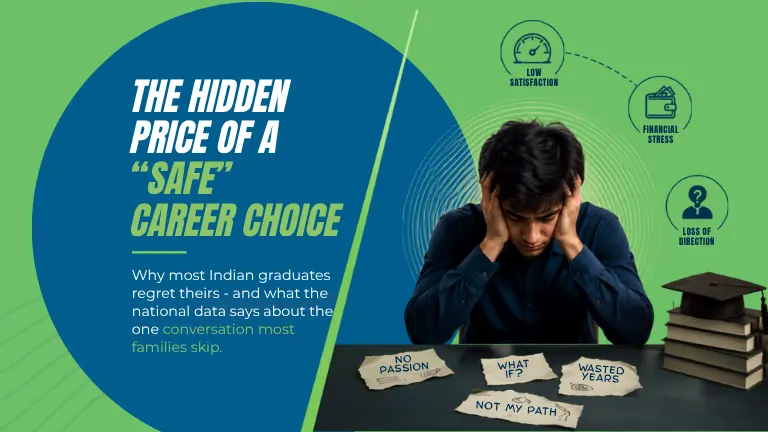
The hidden price of a “safe” career choice
Why most Indian graduates regret theirs – and what the national data says about the one conversation most families skip.
Six years since Class 11. Third attempt at CA Intermediate. Still not qualified.
That’s the actual price of a “safe” choice – measured in years, not fees.
It started with one conversation in Class 11 that took about twenty minutes. One relative had done well in Commerce. Another relative’s detour into a less conventional field “hadn’t worked out.” So the stream got picked – not because anyone tested where her strengths actually pointed, but because one path looked proven and the other looked risky. Nobody sat her down to ask what she actually wanted to spend her days doing.
She is not unusual. She is one data point in a national pattern that Indian parents rarely see quantified – until now.
Ninety percent of India’s students choose blind
A UN-backed national survey – the Bharat Career Aspirations Report 2025, from UNICEF YuWaah and iDreamCareer – assessed 21,239 students from Classes 9–12 across multiple Indian states and found that only 10.4% receive any form of professional career guidance. The remaining 89.6% make one of the most consequential decisions of their life based on family opinion, neighbourhood trends, or “what worked for someone else.”
of Indian students (Classes 9–12) have access to any professional career guidance – Bharat Career Aspirations Report 2025
India’s actual student-to-career-counsellor ratio, against a globally recommended benchmark of 1:250
trained career counsellors nationally, serving roughly 350 million school-age students – many rural and semi-urban schools have none at all
of India’s graduates and postgraduates report regretting their career choice or lacking real clarity about the work they want to do
Most teenagers can’t even name the career they’re aiming for
The ASER 2023 survey of 14–18-year-olds across 28 districts and 26 states – 34,745 youth in total – found that 20% cannot name a specific career they are working toward at all. Even among those with an aspiration, 42.5% of males and 48.3% of females report having no visible role model in their desired field – no one they can watch, ask, or learn from at close range.
Regret at 86% prevalence is not a personality flaw in a generation – it’s the statistically expected output of a system where 9 in 10 decisions are made without structured input.
The clearest, most data-backed example
Chartered Accountancy is repeatedly chosen as the archetypal “safe, respectable, well-paying” path for commerce students – which makes it the sharpest test case for what happens when a career is picked for its reputation rather than fit. ICAI publishes hard pass-rate numbers every cycle that most other streams don’t, so the real cost of a mismatch is unusually visible here.
CA Intermediate pass rate (both groups), ICAI September 2025 results
CA Final pass rate, ICAI September 2025 results – the modal outcome is at least one repeated attempt
typical time to qualify – Foundation, Intermediate, two years’ Articleship, and Final – even one repeated stage stretches this well past the minimum
mandatory Articleship (recently reduced from three years by ICAI) – a substantial, non-negotiable commitment before the qualification is even complete
This is not a criticism of CA as a profession – it remains a genuinely strong career for the right person. The issue is the selection process: a subject chosen because it’s “respectable” and “someone we know did well in it,” with no assessment of whether the student has the specific aptitude – sustained solitary study discipline, comfort with rule-based technical detail, tolerance for multi-year deferred reward – that the CA path specifically demands. The same misalignment plays out with engineering, medicine, and law; CA simply shows it most clearly in the data.
Parents aren’t making a bad decision – they’re outsourcing it
The uncomfortable throughline connecting all of the above statistics is time – specifically, whose time went into the decision. When 89.6% of students choose without guidance, it is rarely because parents don’t care. It’s because the decision quietly defaults to the path of least friction: what a relative did, what the coaching centre is already selling seats for, what “everyone is doing this year.” Busy parents aren’t making a bad decision – they’re outsourcing the decision to social proof, and social proof is not the same as fit.
The price shows up later, and it’s not abstract: a graduate re-attempting a professional exam for the third time is not just delayed – they’re also not accumulating the industry experience their peers are, compounding an income and confidence gap that widens every year the mismatch continues.
The decision audit
This is not a personality test or a career-aptitude quiz – those already exist and are widely available. This is a shorter, more honest audit meant to be done together, once, at the point of stream or course selection (Class 10 or Class 12), and repeated if a child asks to pivot mid-degree.
The time-spent check
In the last six months, how many hours has the family spent specifically discussing this decision, versus hours spent discussing coaching logistics or admission cutoffs? If logistics dominate, fit hasn’t been assessed yet.
The three-alternatives test
Can your son or daughter name three other career paths they seriously considered, beyond the current one? If the answer is one path with no real alternative ever explored, the “choice” may be closer to a default.
The source-of-decision test
If asked “why this path,” does the answer reference a specific personal strength or interest – or a person (“my uncle did it,” “my friend’s parents said”)? The latter is a signal worth investigating further, not dismissing.
The stress-test question
Ask: “If this career paid the same as your second-favourite option, would you still choose it?” Compliance-driven choices often reveal themselves here.
Exit-plan clarity
Under NEP 2020’s multiple entry-exit framework, most degrees now allow a certificate after year one and a diploma after year two before full commitment. Does your child know this safety net exists, or do they believe – incorrectly – that switching later means starting over?
The takeaway
The 86% regret figure is not evidence that Indian students are indecisive – it’s evidence that career decisions in India are structurally under-resourced, with a counsellor-to-student ratio twelve times worse than the global benchmark. Parents don’t need to become professional counsellors to close this gap. They need roughly one structured conversation, using a framework like the one above, replacing the single dinner-table decision that currently stands in for it.
Replace the dinner-table decision with a structured one.
If it would help to run this audit together with an outside, expert read on your son or daughter’s actual aptitude – not just family precedent – a 15-minute conversation is all it takes. No commitment, no pressure.
Book your 15-minute conversation