If you’ve just finished 12th, you’ve probably heard this question more times than you’d like:
“So… what are you planning to take next?”
And along with that come opinions:
- “Science is the safest option.”
- “Commerce has good scope.”
- “Arts is risky.”
Somewhere in all this, you’re expected to make a decision that quietly shapes the next few years of your life.
But here’s the truth most people don’t tell you:
- You’re not just choosing a stream
- You’re choosing how your daily life will feel for the next 3–4 years
So instead of asking “Which is better?”, a better question is:
“Which one actually fits how I think, learn, and work?”
Let’s break that down.
If You Continue with Science
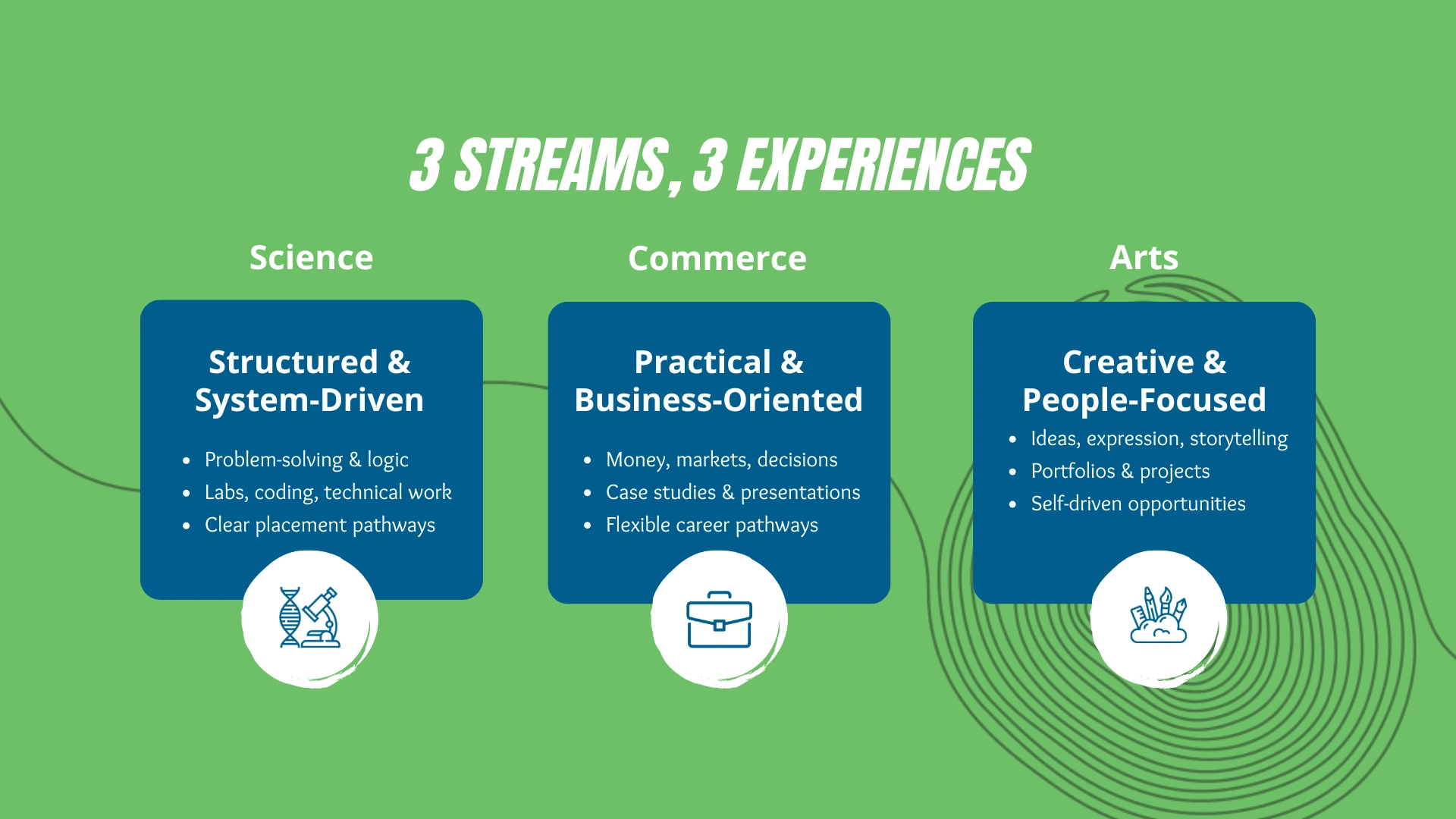
Choosing Science – whether it’s engineering, B.Sc, pharmacy, or similar paths, usually means stepping into a more structured academic environment.
In the early years, your time is spent understanding concepts, solving problems, and working through labs and assignments.
There’s a clear system: learn → apply → test.
As you move forward, things become more specialised. You might explore areas like AI, electronics, biotech, or data-related fields, while also working on projects and internships.
Over time, you naturally get comfortable with:
- Breaking down complex problems
- Working with logic, systems, or code
- Following structured processes
For many students, this clarity is helpful. There’s a visible path – study, specialise, get placed.
But that structure also comes with a requirement: you need to enjoy the process.
If you like solving problems and working with logic, this path feels engaging.
If not, it can start feeling heavy – not immediately, but gradually.
That’s why choosing Science only because it feels “safe” often leads to frustration later.
Key skills:
Communication
- Clear English and Hindi
- Local language helps (e.g., Tamil in Chennai)
If You Move into Commerce
Commerce offers a different kind of experience.
Instead of focusing on formulas and systems, your learning revolves around how businesses function – money, markets, decisions, and people.
In your first couple of years, you’ll build a foundation in areas like accounting, economics, and business concepts. Later, this often extends into practical exposure through internships, projects, or certifications.
Gradually, you become comfortable with:
- Understanding how money flows and decisions are made
- Analysing situations rather than solving fixed problems
- Communicating ideas in business contexts
This path also opens multiple directions. Some students move into jobs after graduation, while others pursue professional qualifications like Chartered Accountant (CA) or Company Secretary (CS).
Compared to Science, Commerce often allows you to enter the working world slightly earlier, but long-term growth depends on how you build on it.
If You Choose Arts
Arts takes you into a more open-ended and expressive learning environment.
Here, the focus shifts from solving predefined problems to exploring ideas, understanding people, and expressing thoughts – through writing, design, media, psychology, or social sciences.
Your growth often comes from:
- Projects and portfolios
- Communication and presentation
- Real-world exposure through internships or creative work
Over time, you build strengths in:
- Creativity and storytelling
- Understanding behaviour and perspectives
- Expressing ideas clearly
Unlike other streams, this path doesn’t always give you a fixed roadmap.
Because success here depends less on the degree itself and more on what you build alongside it.
Students who actively create, explore, and experiment tend to thrive.
Those who wait for direction often feel uncertain.
So How Are These Streams Actually Different?
At a surface level, all three may look like “just degrees.”
But the experience they create is very different.
A Clear Comparison
| Aspect | Science | Commerce | Arts |
| Daily Experience | Concepts, problem-solving, labs | Business scenarios, numbers, case studies | Reading, writing, discussions, creative work |
| Thinking Style You Develop | Structured, logical | Practical, decision-oriented | Interpretive, idea-driven |
| Type of Work | Technical, system-based | Analytical, business-focused | Creative, communication-focused |
| Nature of Assignments | Problem-solving, coding, technical tasks | Reports, presentations, financial analysis | Essays, portfolios, projects |
| Career Entry Path | Often structured (placements) | Mixed (placements + self-driven) | Mostly self-driven + portfolio |
| Growth Depends On | Technical depth & skills | Specialisation & exposure | Portfolio & real-world work |
The Mistake Most Students Make
Most students believe they are choosing a career path.
But in reality, they are choosing a daily lifestyle for the next 3–4 years.
- One path might involve solving problems for hours
- Another might involve analysing business situations
- Another might involve creating, writing, or presenting ideas
The struggle doesn’t come from the stream itself.
It comes when there’s a mismatch between:
- How you naturally think
- And what your stream demands from you every day
And that mismatch doesn’t show up immediately.
It builds slowly – in lack of interest, low energy, and confusion.
What About Career Outcomes?
This is where most decisions become fear-driven.
But outcomes are rarely decided by the stream alone.
- Science often leads to technical or specialised roles
- Commerce opens paths into business, finance, and management
- Arts leads to creative, communication, and people-focused careers
Across all three, one pattern is clear:
👉 Skills and exposure matter more than just the degree
Even insights from NASSCOM consistently highlight that employability improves significantly with practical skills and real-world experience.
A Simple Way to Decide
Instead of trying to pick the “right” option, try noticing what feels natural.
Which of these feels closest to you?
- You enjoy solving problems and working through logic
- You enjoy understanding money, business, or decisions
- You enjoy expressing ideas, creating, or analysing people
You don’t need a perfect answer.
You just need an honest one.
What Most Students Realise Too Late
There is no “safe” stream.
There is only:
- A stream that aligns with how you think
- And one that doesn’t
A mismatch doesn’t fail instantly.
It shows up slowly – in motivation, performance, and clarity.
If You’re Still Confused
If you’re unsure which stream truly fits your strengths, it’s worth taking a step back before making a decision.
Understanding how you think, what you enjoy, and how you naturally work can help you avoid choosing a path that feels forced later.
At Elysian Inspires, we work with students to:
- Identify the right stream and career direction
- Understand their strengths and thinking style
- Make clear, informed decisions without confusion
You can start with a simple conversation and gain clarity on what suits you best.