


Can DMIT Shape Your Child’s Future? A Complete Guide for Parents
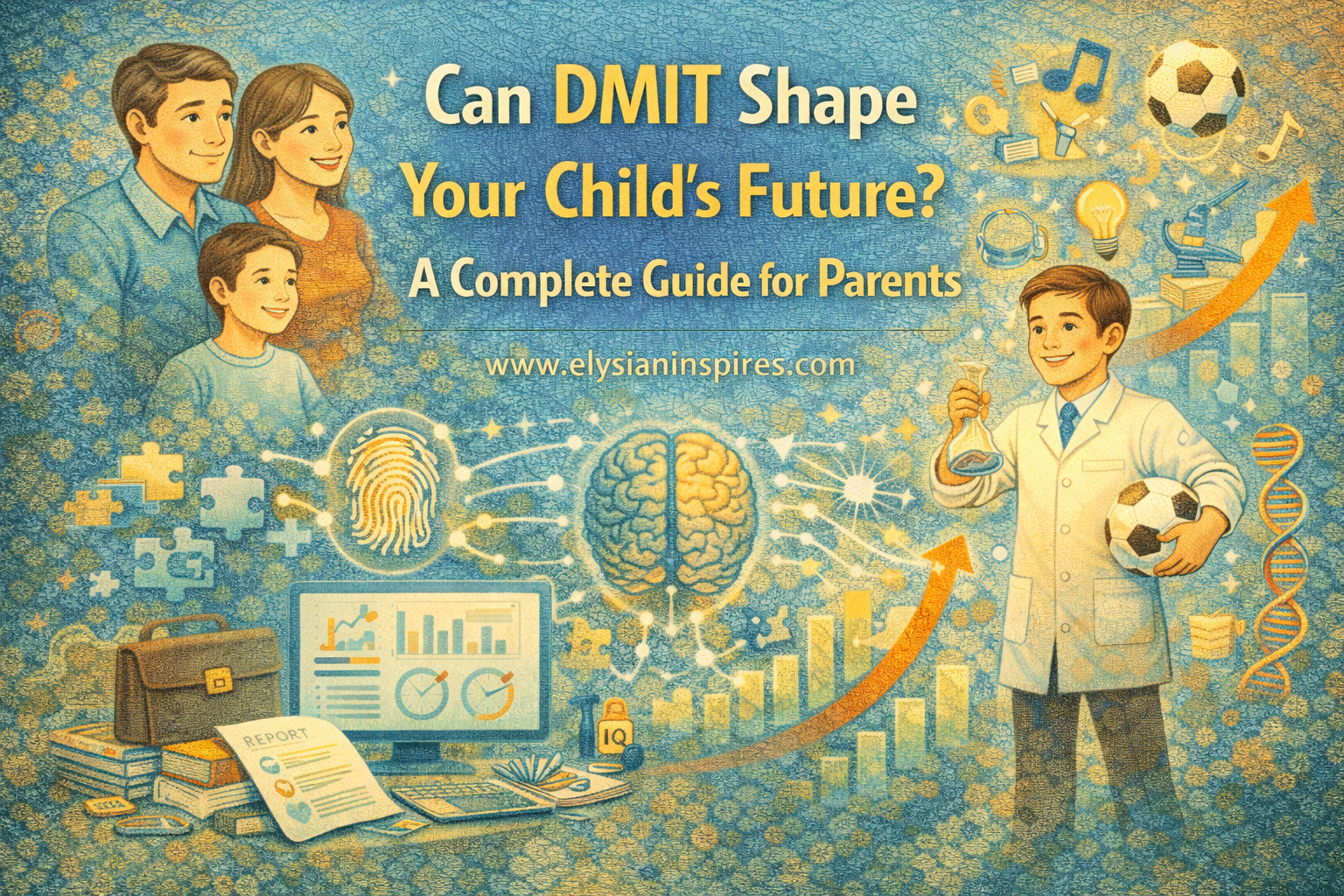
A DMIT Test (Dermatoglyphics Multiple Intelligence Test) can help shape your child’s future only in one practical way: it can give parents and teenagers structured clues about natural strengths, learning preferences, and motivation triggers, so you can make better-informed academic and career decisions. It should not be treated as a “career prediction tool” or a one-test verdict.
What is a DMIT Test, in simple words?
A DMIT Test is an assessment that uses fingerprint patterns as one input to understand a child’s possible inborn tendencies (like learning style preferences and dominant intelligences). The output is usually a report that counsellors interpret and connect to education planning.
At ELYSIAN INSPIRES, DMIT is positioned as a starting point for career and academic counselling, not a replacement for real-world exposure, school performance, or psychological assessment.
Can DMIT shape my child’s future, or is it just hype?
It can shape the future only if you use it like a mirror, not like a map.
A mirror helps your child see themselves clearly: strengths, stress points, and the environments where they learn best.
A map tells you exactly where they must go. DMIT is not that.
If your goal is to reduce confusion after Class 8, 9, or 10, DMIT can be useful as part of a wider guidance plan. If your goal is to “lock a career at 13,” that is where most families get disappointed.
What does a DMIT report typically help you discuss at home?
Think of DMIT as a conversation framework. It can help you discuss:
- Which learning modes feel easier (visual, auditory, hands-on)
- Where your child might show natural comfort (language, numbers, people, design, movement)
- What type of routine supports them (structured vs flexible)
- What demotivates them (pressure, comparison, fear of failure)
This is especially helpful during adolescence, when parent-child communication often becomes strained. If you want parenting support alongside guidance, explore Elysian’s resource on Tips for Parents of Teenagers.

What is the best age to take a DMIT Test?
Most families consider a DMIT Test during transition points, for example:
- Late primary or middle school, when learning struggles first show up
- Before choosing subjects after Class 9 or streams after Class 10
- During Class 11 or 12, when entrance exam pressure rises
The “best age” depends less on the number and more on whether a decision is coming up.
If your child is not facing any choices, you may still do it, but you will get the most value when you have a real question to answer (stream selection, study method, extracurricular direction).
How is DMIT different from psychometric tests and Multiple Intelligence assessments?
Parents often mix these up, so here is a simple comparison.
| Assessment type | What it mainly uses | What it’s good for | What it cannot do alone |
|---|---|---|---|
| DMIT Test | Fingerprint scan + interpretation | Starting conversations about learning preferences and dominant strengths | Predict a “perfect career” with certainty |
| Psychometric tests | Questionnaires about interests, aptitude, personality | Structured career matching, interest patterns, work-style preferences | Replace mentoring, exposure, or skill-building |
| Multiple Intelligence assessment | MI-based questionnaire scoring | Identifying which intelligences are stronger and how to learn better | Decide a stream without checking academics and motivation |
If you want an MI-focused option, Elysian also offers a Multiple Intelligence Analysis that can complement DMIT.
What are the real benefits of DMIT for parents (when used correctly)?
The biggest benefit is not the report, it is what you do next.
When used responsibly, the DMIT Test can help parents:
- Reduce trial-and-error in choosing activities, study methods, and subject combinations
- Stop comparing siblings or classmates (because the discussion becomes strength-based)
- Identify where support is needed (focus, confidence, stress management)
- Plan skill development early (communication, problem-solving, creativity)
This is also where Personality Development fits naturally. Once a child understands their strengths, it becomes easier to build habits like consistency, emotional regulation, and confidence.
Key takeaways for busy parents
- DMIT is best used as a direction tool, not a final decision tool.
- Combine it with school feedback, real projects, and counselling.
- Use results to support Personality Development, not to label your child.
What are the pros and cons parents should know before booking?
Being honest here protects your child and your money.
Pros
- Non-invasive and quick to administer
- Can offer a fresh perspective, especially when parents and teachers disagree
- Helpful for building a customized learning routine
- Can reduce conflict when used in a supportive way
Cons
- Quality varies widely based on provider and interpretation
- Overconfident claims (“guaranteed career outcome”) are a red flag
- Results can be misunderstood as fixed labels
A good counsellor will explain limitations clearly and encourage triangulation with other evidence.
What are the biggest mistakes parents make after getting a DMIT report?
Most problems come from how parents use the report.
“My child is X, so they must become Y.”
This turns guidance into pressure.
Instead, think: “My child has strengths in X, so let’s test 2 to 3 career clusters that use X.”
“Now we don’t need counselling.”
DMIT is data. Counselling is interpretation plus action.
If you prefer flexible access from home (especially with busy school schedules), online counselling for career guidance is a practical next step.
“Let’s tell relatives and teachers so they will ‘push’ the child.”
Teens need safety and privacy. Oversharing often backfires.
How can DMIT support Personality Development, not just career choice?
Many parents focus only on stream selection (Science vs Commerce vs Arts). But long-term success comes from behaviour and mindset.
Here are ways a DMIT-led plan can support Personality Development:
- Confidence building: giving the child language to explain what they’re good at
- Study discipline: designing a routine that matches their attention patterns
- Communication skills: choosing activities that strengthen expression (debate, drama, presentations)
- Decision-making: teaching them to evaluate options, not follow trends
If your teen is emotionally reactive or withdrawn, pair career planning with counselling support. Elysian has counselling resources for student stress too (for example, Counselling For Exam Stress).
How do I talk to my teenager about DMIT results without triggering resistance?
If you are parenting a teen in 2026, you already know this truth: tone matters more than content.
Use these three parent scripts (they work better than lectures):
- “What part of this report feels accurate to you?”
- “Where do you disagree? Give me an example.”
- “What experiment should we try for 2 weeks to test this?”
This approach aligns well with Elysian’s Tips for Parents of Teenagers because it keeps the teen involved.
Also, remind them that results are not a judgement. They are inputs for building skills.
Can you share an example of how DMIT can be used responsibly?
Yes. Here is a realistic example.
Scenario: A 15-year-old (Class 10) is doing okay in math, dislikes rote learning, and spends hours building things (LEGO, DIY, simple coding).
What DMIT might add: It may highlight stronger logical, spatial, or kinesthetic preferences.
What parents can do next:
- Try 2 low-risk projects (a basic electronics kit, a design challenge, a small coding project)
- Speak to teachers about whether practical learning improves performance
- Do one counselling session to map stream choices and workload reality
- Add a Personality Development goal like “weekly presentation practice” to build confidence
Notice what we did here: we used DMIT to create experiments, not conclusions.
What does a trustworthy DMIT-based counselling process look like at ELYSIAN INSPIRES?
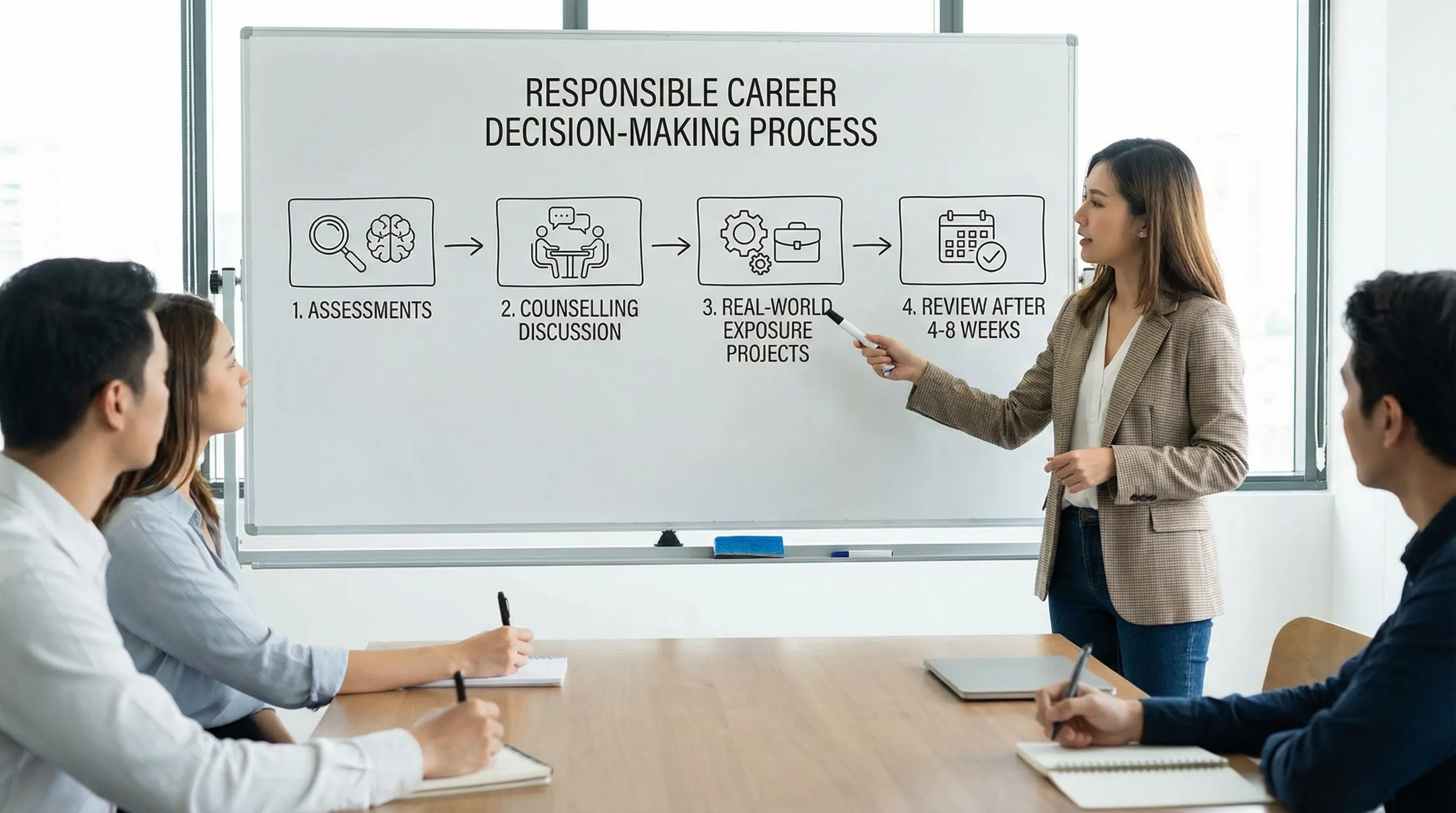
Parents usually get the best outcomes when the process includes assessment plus interpretation plus next steps.
A strong process typically involves:
- Understanding the child’s current situation (grades, interests, stress, family expectations)
- Reviewing assessment findings (DMIT plus other tools when needed)
- Translating results into an action plan (subjects, habits, skill-building, exposure)
- Following up to adjust the plan as the child grows
If you are exploring this option locally, start here: Academic Counselling using DMIT in Chennai.
If you are outside Chennai or prefer home-based sessions, Elysian’s online counselling for career guidance support is explained here: Best Online Career Counselling in India.
How do I know if my child needs online counselling for career guidance after DMIT?
Choose online counselling for career guidance if you notice any of these patterns:
- Your child avoids career conversations or shuts down quickly
- You get daily conflict about studies, tuition, or marks
- The child has interest but no structure (starts things, quits fast)
- You are unsure how to convert strengths into subject choices
Online sessions can also help when both parents work, the child has coaching classes, or you live outside the city.
What are the red flags when choosing a DMIT provider?
Use this quick filter before you book any DMIT Test.
- They promise one “perfect career” based on fingerprints
- They discourage questions or refuse to explain methodology
- They pressure you into expensive bundles without clarity
- They shame your child or label them as “weak”
A good provider will welcome questions, explain limitations, and focus on action.
If DMIT is not destiny, what actually shapes a child’s future?
In real life, careers are built through a combination of:
- Self-awareness (strengths, interests, values)
- Skills (communication, digital skills, problem-solving)
- Exposure (projects, clubs, internships, mentorship)
- Support systems (parents, teachers, counsellors)
DMIT can support self-awareness. Personality Development builds the behavioural foundation. And online counselling for career guidance can keep the plan realistic and updated.
Quick parent checklist: what to do in the first 30 days after DMIT
Keep it simple and consistent.
- Pick 1 to 2 strengths from the report to nurture
- Pick 1 challenge area to support (focus, confidence, stress)
- Run one real-world “trial” (project, class, club, volunteering)
- Schedule one guidance session to connect dots and reduce confusion
If you want a supportive starting point, explore Elysian’s career guidance resources and counselling services at elysianinspires.com.
Frequently Asked Questions
Can DMIT shape your child’s future?
What is a DMIT Test and what does it measure?
Is DMIT accurate enough to choose a career for my teenager?
What is the best age to take a DMIT Test?
How can parents use DMIT results for personality development?
Should I choose online counselling for career guidance after DMIT?
How do I talk to my teenager about DMIT results?
Where can I get DMIT-based academic counselling in Chennai?
Academic Counselling Using DMIT in Chennai
