


Does Having a Job Make Women Strong and Independent?
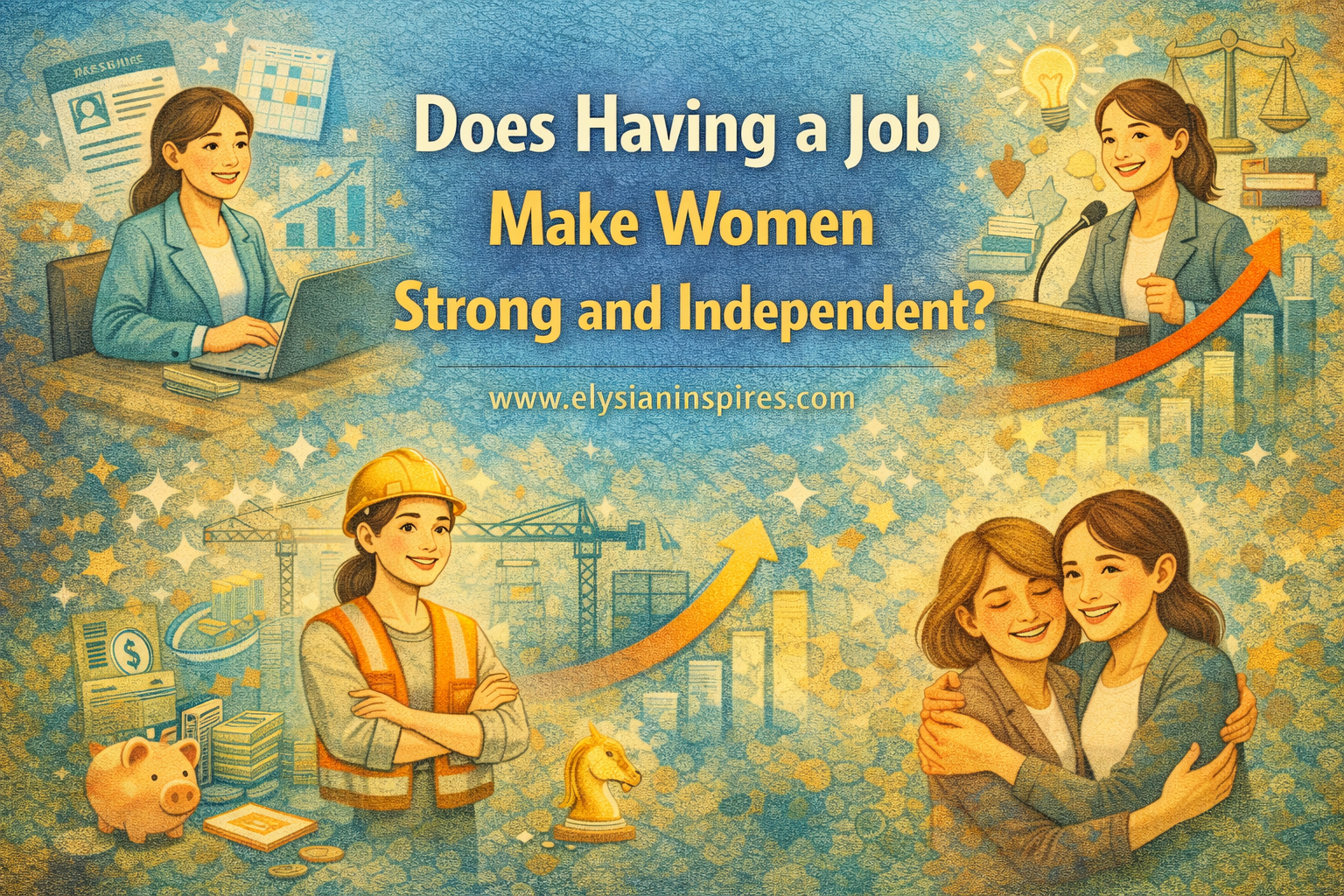
A job can support a woman’s strength and independence by giving her income, skills, identity, and decision-making power, but it does not automatically do so. Strength and independence grow when the work is safe, fairly paid, aligned with strengths, and backed by supportive choices at home and in society. Elysian inspires Chennai
What are the key takeaways if you’re searching this question?
- A job often improves financial independence, confidence, and social exposure.
- A job can also create new pressures (workload, safety, guilt, burnout) if support systems are weak.
- Independence is not only money, it is also choice, voice, and boundaries.
- The “right job” matters more than “any job.”
- If you feel stuck, online counselling for career guidance can help you choose work that fits your life stage.
Does having a job automatically make a woman strong and independent?
Not automatically.
Work can be empowering, but strength is not “granted” by a job title. It is built through skills, self-trust, financial literacy, and supportive environments.
A helpful way to think about it is this: employment is a tool. Like any tool, the result depends on how and where it is used.
What does “strong and independent” actually mean in real life?
In counselling sessions, we usually break this down into practical markers.
Strength often looks like resilience, clarity, and confidence under stress.
Independence often looks like choice, mobility, and the ability to say “yes” or “no” without fear.
Here are common dimensions of independence.
| Dimension | What it looks like day to day | How a job can help | When a job may not help |
|---|---|---|---|
| Financial | Paying bills, saving, emergency fund | Income, credit history, benefits | Low pay, irregular income, unpaid labour |
| Decision-making | Choosing where to live, what to study, when to switch roles | More bargaining power, confidence | Controlling partner/family, restricted access to money |
| Social | Networks, mentors, exposure | Professional circles, role models | Toxic workplace, isolation, harassment |
| Psychological | Self-worth, identity, purpose | Mastery, recognition, autonomy | Burnout, constant criticism, role mismatch |
So yes, a job can strengthen independence, but only if the job and the system around it are healthy.
How exactly does a job make many women stronger?
Does earning money change confidence?
For many women, earning creates visible proof of capability.
It also reduces the “asking permission” dynamic for basic choices.
Money is not everything, but it often becomes the foundation for other freedoms.
Does work build skills that translate into independence?
Yes, especially skills like communication, problem-solving, negotiation, and digital literacy.
These skills spill into personal life too, such as setting boundaries and advocating for needs.
Does employment improve social support and identity?
Often, yes.
A workplace can provide mentors, friendships, and a sense of belonging beyond family roles.
This matters because independence is not only self-reliance, it is also access to supportive networks.
For broader context, organizations like UN Women highlight how economic participation supports women’s empowerment at multiple levels.
When can a job fail to create independence (or even reduce it)?
What if the job pays too little or is unstable?
A job that barely covers commuting, childcare, or essentials may not increase independence.
It can also create financial stress that reduces confidence.
What if the workplace is unsafe or biased?
Safety and dignity are not optional.
If a woman constantly navigates harassment, discrimination, or fear, the job can drain her mental strength.
(India has legal protections like the POSH framework for workplace harassment, but real protection still depends on implementation and support.)
What if she carries a “double shift” at home?
Many women work a full day and still do most domestic and caregiving work.
Without shared responsibilities, employment can become exhaustion, not empowerment.
What if she feels trapped in the wrong role?
A role that clashes with personality or strengths can create chronic stress.
This is where online counselling for career guidance can be useful, because clarity reduces wasted years.
Is it possible to be strong and independent without a job?
Yes.
Women can be strong through education, entrepreneurship, caregiving leadership, community roles, or managing a household with real decision authority.
But there is an important catch.
Without personal income, independence can become vulnerable during crises (health issues, divorce, job loss of a partner, unexpected responsibilities).
That is why many counsellors recommend at least one of these:
- A marketable skill
- A personal income stream (job, freelancing, business)
- A financial safety plan (savings, insurance, documents, bank access)
Is any job better than no job?
Not always.
Some jobs build long-term strength. Others only consume time.
Here is a simple comparison many clients find helpful.
| Type of work situation | Likely outcome for strength and independence | Best for |
|---|---|---|
| Skill-building role with mentorship | Strong growth in confidence and career capital | Students, early-career women |
| Stable job with fair pay | Strong financial independence | Anyone building security |
| High-stress job with poor boundaries | Income may rise, wellbeing may fall | Short-term goals only |
| Flexible work (remote, part-time) | Good balance if pay is decent | Mothers, caregivers, re-starters |
| Unsafe or biased workplace | Weakens confidence and safety | Avoid, plan an exit |
This is why the better question is often “Which job makes me strong and independent?”
What are the pros and cons of having a job for women?
Pros
- Financial independence and stronger savings habits
- Better negotiation power in family decisions
- Expanded identity beyond family roles
- Faster skill development and career mobility
- Wider social network and access to mentors
Cons
- Work-life conflict when household load is unequal
- Safety and harassment risks in some environments
- Pay gaps and biased promotions in certain sectors
- Guilt and social pressure, especially for mothers
- Burnout when boundaries are weak
If you are weighing these, counselling can help you choose roles and environments that protect both career growth and wellbeing.
What examples show how jobs can (or cannot) build independence?
Example 1: A final-year student choosing her first job
A commerce graduate takes the first offer only because friends joined.
She feels anxious and underconfident within 3 months.
After a strengths-based assessment and career planning, she pivots to a role that matches her interests and communication strengths.
Her confidence rises because her daily work finally fits her.
If you are at this stage, explore ELYSIAN INSPIRES’ approach to assessments through their resource on psychometric tests and career impact.
Example 2: A mother returning after a career break
She wants income, but also needs predictable hours.
A flexible role plus skills refresh helps her restart without burnout.
The “strength” here is not only earning, it is rebuilding identity and confidence.
A structured plan like a restart roadmap can be supported through professional guidance, and online counselling for career guidance is often the easiest way to start while managing home responsibilities.
Example 3: A woman in a toxic workplace
Her salary is good, but she dreads Mondays.
She stops speaking up, sleeps poorly, and feels stuck.
In this case, the job is not making her stronger, it is draining her.
A strategic exit plan (skills, savings runway, switching timeline) restores independence.
If a job helps, why do some women still feel “not independent”?
Because independence is not only external.
In many Q and A discussions, these patterns appear repeatedly:
- “I earn, but I can’t decide how to spend.”
- “I work, but I still need permission for major choices.”
- “I’m employed, but I feel replaceable and insecure.”
This is where mindset, boundaries, and financial systems matter.
Independence becomes real when income, agency, and self-trust move together.
What can parents do to raise strong, independent daughters (without pressure)?
Parents play a major role in confidence building.
Try focusing on capability, not control.
- Encourage exploration, internships, and real exposure
- Teach practical money skills early (budgeting, saving, banking)
- Avoid comparisons with siblings or relatives
- Support “skill first” thinking, not only marks
- Consider career planning sessions when stream or degree choices feel confusing
If you want structured support, ELYSIAN INSPIRES offers guidance for families too, see Family Counselling in Chennai.
What practical steps can women take to become strong and independent through work?
How do I choose a career that strengthens me (not drains me)?
Choose based on strengths, values, and constraints.
A good first filter is:
- What am I naturally good at?
- What kind of environment helps me thrive (people-facing, analytical, creative, structured)?
- What constraints exist right now (time, caregiving, health, location)?
If you want a strengths map, ELYSIAN INSPIRES offers Multiple Intelligence Analysis, which many students and adults use as a starting point.
How do I build independence faster in the first 2 years of working?
Keep it simple and consistent.
- Track your achievements monthly (numbers, outcomes, feedback)
- Build one high-value skill per quarter
- Create a savings habit, even if small
- Learn to negotiate respectfully (salary, scope, timelines)
- Build your professional network steadily
To improve employability basics, you can also use ELYSIAN resources like resume writing tips and job interview tips.
What if I’m confused, overwhelmed, or facing family pressure?
That is common, especially in major transition points.
This is where counselling works best, because it provides a neutral space to think clearly.
If you are not able to visit in person, online counselling for career guidance can help you shortlist options, plan skills, and create a timeline.
For local support, you can explore professional career counselling in Chennai.
So, does having a job make women strong and independent?
It can, and often it does, when the work is decent, the pay is fair, and the woman has real agency over her choices.
But the deeper answer to “Does Having a Job Make Women Strong and Independent?” is this.
A job is a powerful platform, not a guarantee.
When you align work with strengths, build skills, protect wellbeing, and create financial systems, the job becomes a pathway to lasting independence.
If you want personalized direction, ELYSIAN INSPIRES offers online counselling for career guidance and in-person support.
You can also reach the team via their career counsellor contact number page.
Frequently Asked Questions
Does having a job make women strong and independent?
Can a woman be independent without a job?
What kind of job best supports women’s independence?
How can parents support a daughter’s career without pressure?
How can online counselling help women choose the right career?
What should I do if my job is affecting my mental health?
