


Dreaming of Becoming an Aerospace Engineer? Start with These High School Steps
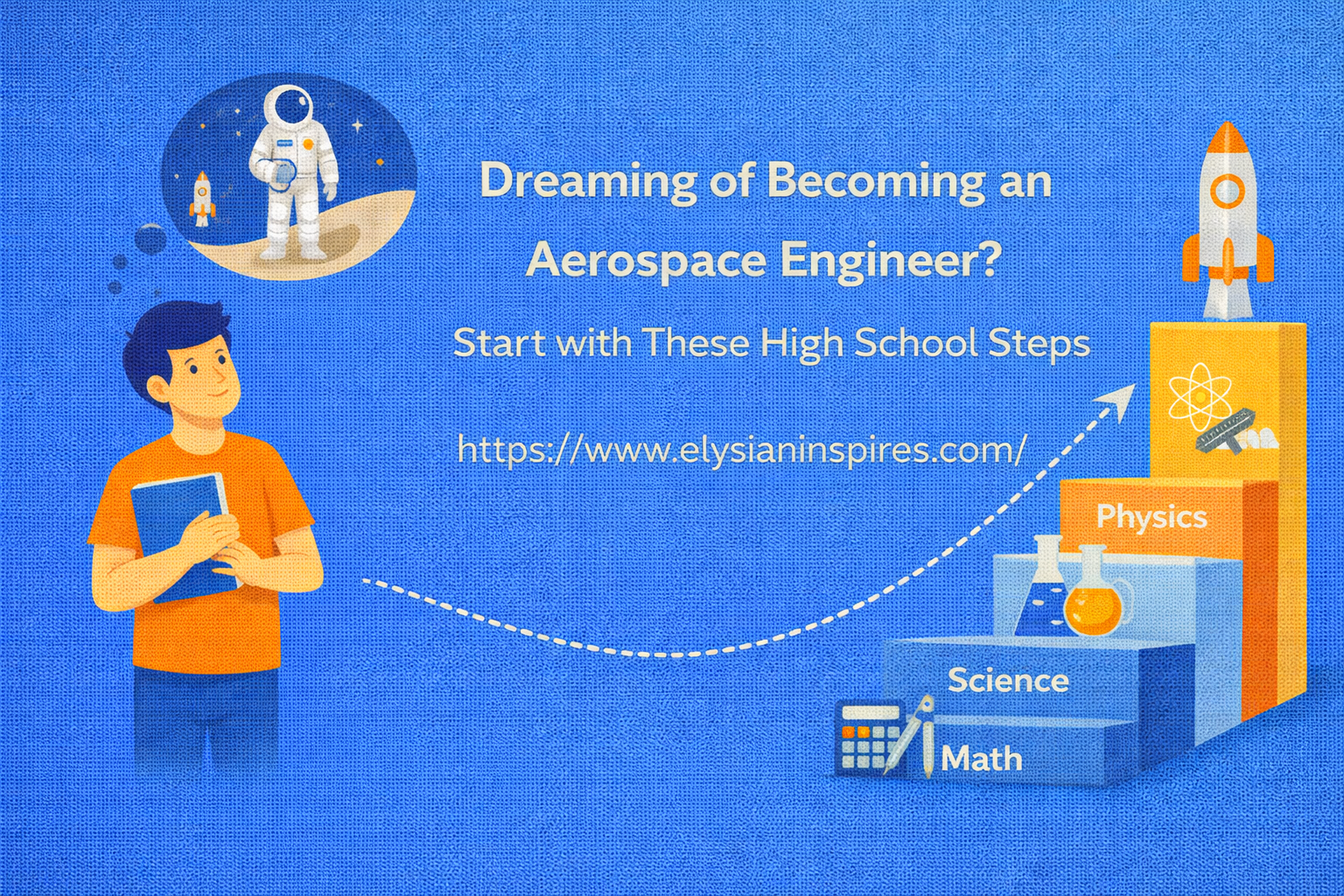
An aerospace engineer designs, tests, and improves aircraft, rockets, satellites, and the systems inside them. If you are dreaming of becoming an aerospace engineer, the smartest high school steps are simple: master Maths and Physics, build a few proof-of-work projects, and choose the right entrance-exam path after Class 12.
“What does an aerospace engineer actually do?”
Aerospace engineering is not just “building rockets.” It is a mix of physics, maths, computing, design, and safety.
Typical areas include:
- Aerodynamics (how air flows around wings and bodies)
- Propulsion (jet engines, rocket engines)
- Structures & materials (strength, fatigue, lightweight design)
- Avionics & control (sensors, guidance, stability)
- Space systems (satellites, launch vehicles, mission design)
If you enjoy “why does this fly?” questions and you like solving problems step by step, you are already thinking like an engineer.
“Which school subjects matter most for aerospace engineering?”
In India, your subject choices decide how many doors stay open.
“Do I need PCM?”
Yes, PCM (Physics, Chemistry, Maths) is the most direct route for aerospace/aeronautical engineering admissions.
Here is what each subject trains you for:
| Subject | Why it matters for aerospace | What to focus on in high school |
|---|---|---|
| Maths | Calculus, vectors, modelling, optimisation | Functions, trigonometry, calculus basics, coordinate geometry |
| Physics | Mechanics, fluids, electricity, modern physics | Kinematics, rotation, gravitation, waves, basic electricity |
| Chemistry | Materials, fuels, corrosion, composites | Bonding, thermodynamics basics, chemical kinetics |
| English | Clear technical communication | Writing summaries, presentations, reading comprehension |
| CS (optional) | Simulation, data, automation | Python basics, plotting, simple numerical problems |
If you can add Computer Science, it helps, but PCM is the non-negotiable foundation.
“What should I do in Class 9 and 10 if I’m serious early?”
You do not need coaching in Class 9 to be “ahead.” You need consistency.
Use this simple foundation plan:
- Build strong algebra and trigonometry, because Class 11 physics depends on it.
- Treat NCERT-style concept clarity as your default standard.
- Start a curiosity notebook: flight facts, space missions, questions you want to explore.
- Learn basic Python (loops, functions), just enough to compute and plot simple graphs.
This is also a good stage for structured career guidance so you do not confuse “interest in space” with the day-to-day reality of engineering.
“What should my Class 11 and 12 plan look like?”
Class 11 and 12 are where most students lose confidence, mainly because they underestimate the jump.
“How do I balance Boards and entrance prep?”
Think of Boards as “syllabus mastery” and entrance exams as “speed + application.” You need both.
A practical weekly rhythm:
- 4 days concept learning + short practice
- 2 days mixed practice (previous topics + current topics)
- 1 day review (error log + weak areas)
Keep an error log from Day 1. That habit alone upgrades your preparation quality.
If anxiety hits during the year, do not ignore it. Academic pressure is real, and timely support keeps you stable for the long run.
“Which entrance exams and pathways lead to aerospace engineering in India?”
Your route depends on the college and the branch naming.
“Is it ‘Aerospace’ or ‘Aeronautical’ engineering?”
Both are related.
- Aeronautical is more aircraft-focused.
- Aerospace includes aircraft plus space systems.
In India, many top institutes offer aerospace-related programs through engineering entrances.
“What exams should I track?”
Common pathways include:
- JEE Main and JEE Advanced for IITs and several top engineering options.
- Institute-specific exams (varies by institute).
- State counselling routes for related branches, then you can specialise later via projects, minors, or higher studies.
For official mission context and inspiration, explore ISRO’s official site and NASA’s learning resources like the NASA Glenn Beginner’s Guide to Aeronautics.
If you want structured exam context across streams, you can also read Elysian’s overview on career guidance in science after 12th.
“What skills beyond marks make an aerospace student stand out?”
Marks open the door, skills help you grow inside the room.
High-signal skills for aerospace:
- Problem solving (can you break a big problem into small steps?)
- Programming (Python is enough to start)
- CAD basics (design thinking, 3D visualisation)
- Electronics basics (sensors, Arduino-style prototyping)
- Communication (explaining your project clearly)
These are also the skills that later make your internship search, and even your first job application, much easier.
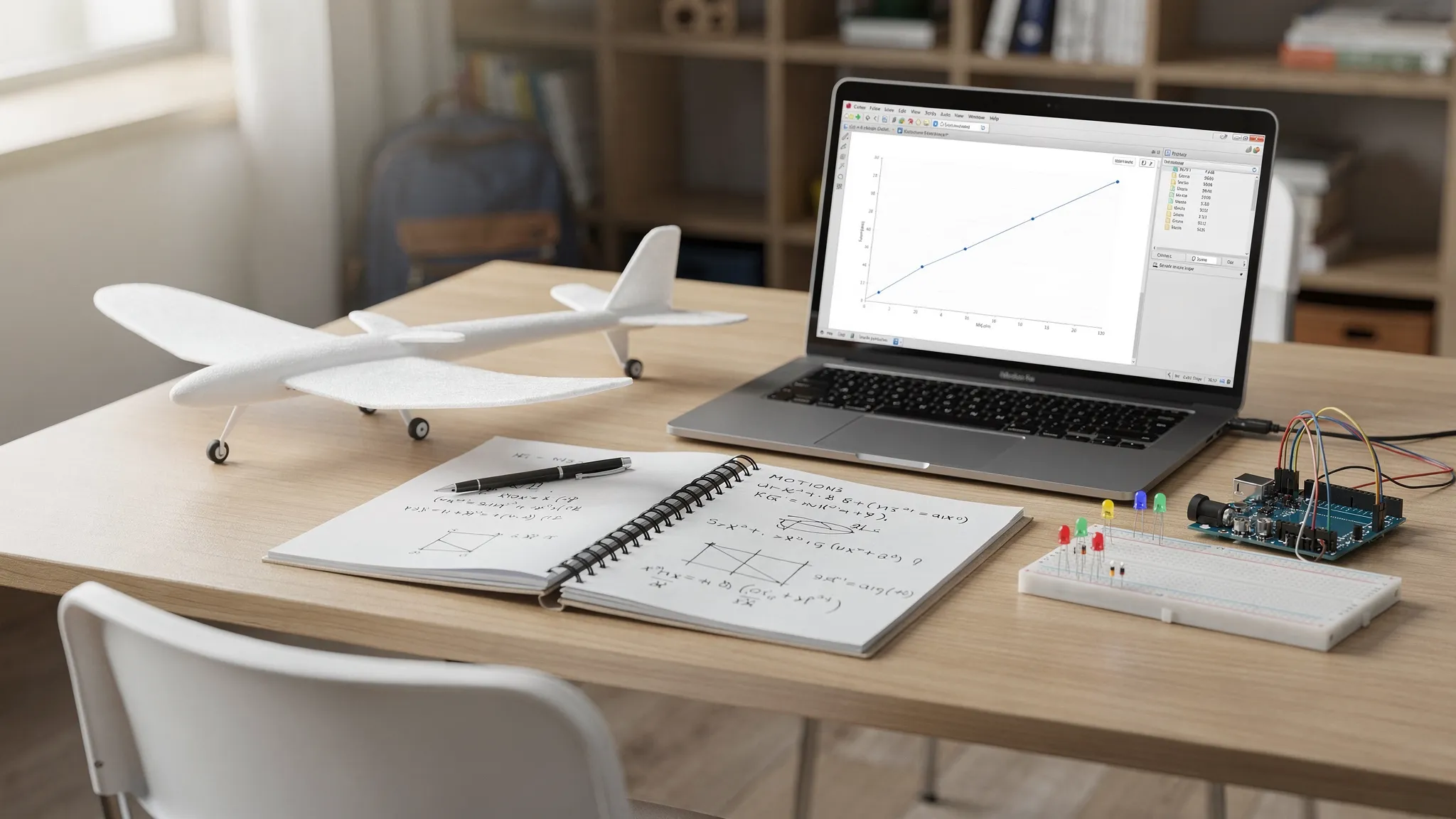
“What projects can I do in high school for aerospace?”
You do not need expensive kits. You need projects that show learning, iteration, and documentation.
“What are beginner-friendly project ideas?”
Try one from each level:
- Level 1 (1 weekend): Build 3 paper/foam gliders with different wing shapes, measure flight time and distance, write a 1-page conclusion.
- Level 2 (2 to 4 weeks): Water rocket with 2 design variations, track launch angle vs range, plot results.
- Level 3 (4 to 8 weeks): Arduino-based altimeter mock (sensor reading + logging), explain how it could be used in a model rocket.
“What makes a project ‘impressive’ to mentors?”
Not the complexity, but the evidence.
A strong project file includes:
- Goal (one sentence)
- Assumptions (what you simplified)
- Method (what you built and tested)
- Results (numbers, graphs, photos)
- Reflection (what failed, what you changed)
That reflection is where engineering thinking shows up.
“Which clubs, competitions, and courses should I consider?”
You want activities that create outputs, not just participation certificates.
“What should I join at school?”
Look for:
- Robotics club
- Science club (with real exhibits)
- Astronomy club (even simple observations and presentations help)
- Makers community in your city (weekend workshops)
“Which online courses are safe bets?”
For Indian students, NPTEL is a reliable place to learn engineering fundamentals over time.
Choose courses that strengthen basics (math, mechanics, programming) before you jump into advanced aerospace topics.
“How do I know aerospace is right for me, not just a ‘cool dream’?”
This is where many students need honest career guidance, because aerospace has a strong brand appeal.
Ask yourself:
- Do I enjoy Maths and Physics even when they get hard?
- Am I patient with iteration (trying, failing, improving)?
- Do I prefer building real things over only watching space videos?
“What if I love space, but I’m not sure about engineering?”
That is valid.
Space-related careers also exist in:
- Physics and astronomy
- Computer science (simulation, AI, imaging)
- Electronics and instrumentation
- Materials science
- Data analytics for satellite data
A good decision is not “aerospace vs not aerospace.” It is “what role in the space ecosystem fits me?”
“Aerospace vs Mechanical vs ECE: which is better for a future in aviation/space?”
Many students worry that choosing Mechanical or ECE means giving up on aerospace.
In reality, space and aviation teams are multi-disciplinary.
| Branch | Where it fits in aerospace/space | Pros | Trade-offs |
|---|---|---|---|
| Aerospace/Aeronautical | Flight, structures, propulsion, design | Direct alignment | Narrower label if you later pivot |
| Mechanical | Structures, thermal, manufacturing, design | Broad and flexible | You must self-build aerospace-specific proof |
| ECE/EEE | Avionics, sensors, control, comms | Huge demand for electronics | Maths-heavy, needs strong circuits foundation |
| CSE | Simulation, autonomy, data, software | Fast-growing roles | Less “hardware” unless you pursue it |
This is why personalised career guidance matters. Your best branch is the one that matches both interest and aptitude.
“What are the real pros and cons of aerospace engineering as a career (2026 view)?”
Aerospace is exciting, but it is also demanding.
Pros
- You work on high-impact systems (safety, national programs, deep tech)
- Strong learning curve, strong long-term skill value
- Opportunities across defence, aviation, space, drones, and R&D
Cons
- Fewer entry-level roles compared to general software hiring
- Some roles require higher studies or deeper specialisation
- Work can be process-heavy due to safety and compliance
If you want a reality check on roles, follow what organisations publish about programs and missions (for example, ISRO and major aerospace companies).
“How can ELYSIAN INSPIRES help me plan this path from school itself?”
Aerospace is a long runway career. Small wrong turns (wrong stream, wrong exam focus, wrong expectation) can cost years.
If you want personalised direction, ELYSIAN INSPIRES supports students with:
- Scientific assessments and counselling to map strengths and learning style
- Study and stream clarity after Class 10 and Class 12
- Profile building guidance for projects and applications
You can explore their assessment-led approach through:
- Multiple Intelligence Analysis
- Psychometric tests and career impact
- Academic counselling using DMIT in Chennai (best used as one input, not the only deciding factor)
If you are looking specifically for career counseling chennai, Elysian’s team offers personalised sessions for students and parents, including stress support and planning.
If you are outside Chennai or need flexibility, you can also consider online counselling for career guidance through Elysian’s remote sessions, which is useful during board years.
Many families also search for the best career counsellor in india when the goal is a premium STEM roadmap. A practical way to choose is to check the counsellor’s assessment methodology, ethics, and whether you receive an actionable plan, not just “suggested careers.”
For students who later need profile support, Elysian also shares practical resources like this guide on resume writing tips.
Key takeaways (save this)
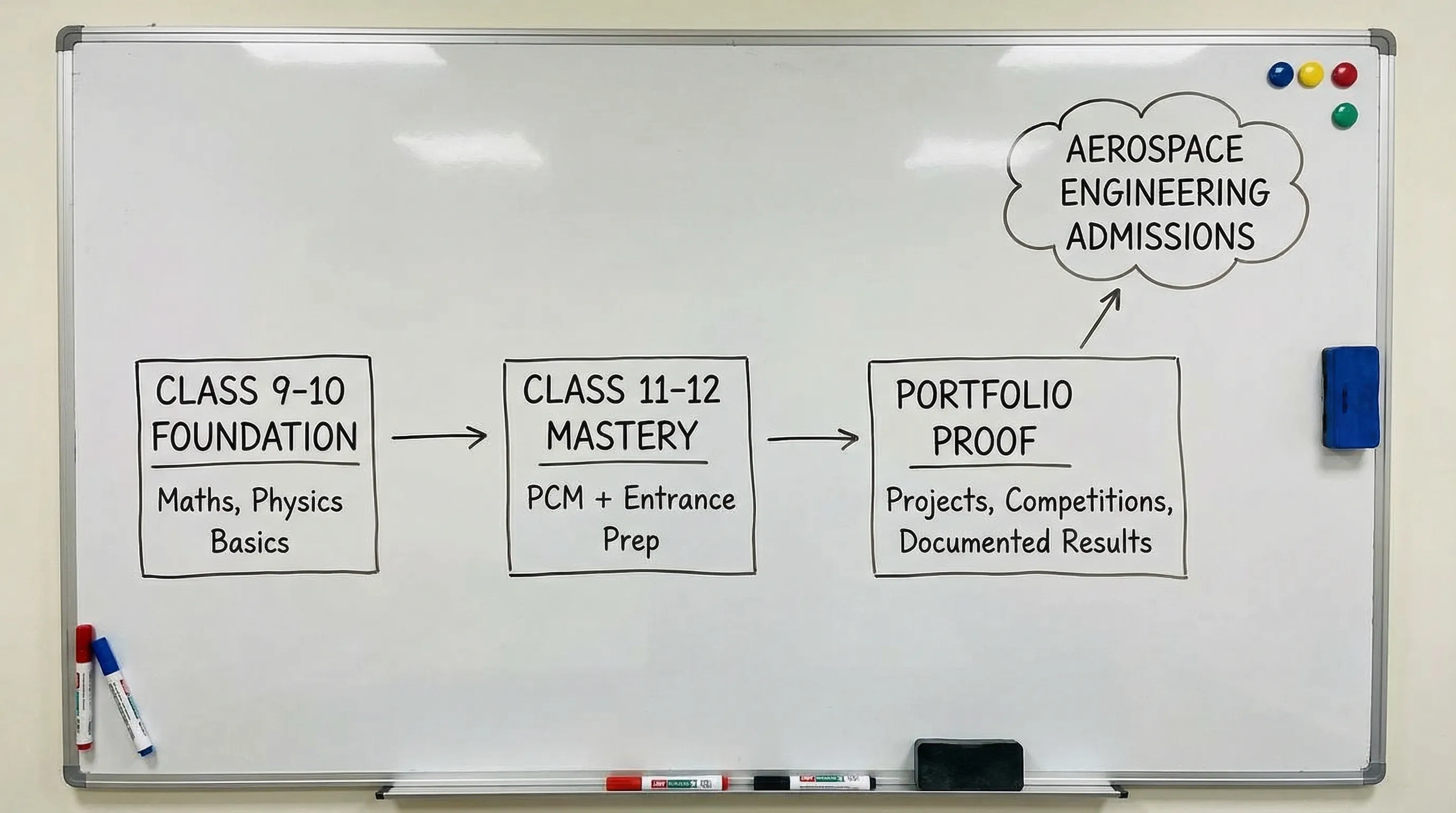
- Aerospace engineering starts in high school with Maths + Physics mastery.
- Do at least 2 proof-of-work projects and document results.
- Keep options open by understanding branch flexibility (Aerospace, Mechanical, ECE, CSE).
- Use assessments and mentoring for faster clarity, this is where career guidance and career counseling chennai can prevent expensive wrong turns.
- If travel or time is a challenge, online counselling for career guidance can keep you consistent.
Frequently Asked Questions
What subjects should I choose in Class 11 to become an aerospace engineer in India?
Is aerospace engineering only for students with very high marks?
What are the best high school projects for aerospace engineering?
Can I work in the space sector if I study Mechanical or ECE instead of Aerospace?
How does career counselling help a student who wants aerospace engineering?
Where can I get career counseling Chennai for aerospace engineering planning?
Is online counselling for career guidance effective for Class 10 and 12 students?
