


Hidden Interview Tactics to Boost Your Hiring Chances
Hidden interview tactics are small, often unspoken moves (before, during, and after the interview) that help recruiters feel confident you can do the job, work well with the team, and ramp up fast, so your hiring chances go up even when competition is strong. career counselling for job interview
Most candidates prepare “answers”. High performers prepare signals: proof, structure, and smart questions that make an interviewer think, “This person will be easy to hire.” Career Consult
“What are recruiters actually scoring me on (even if they don’t say it)?”
Recruiters rarely score you on “confidence” in a general sense.
They score you on predictability.
That usually means three hidden criteria:
- Role fit: Can you do the work with minimal hand-holding?
- Team fit: Will you communicate clearly, take feedback, and stay stable under pressure?
- Risk: Will you quit soon, struggle with basics, or create conflict?
This is why classic job interview tips like “dress well” help, but they are not enough.
Your goal is to reduce perceived risk and increase perceived impact.

“What’s the fastest way to stand out in the first 90 seconds?”
Use a Role-Match opener.
Most people waste the opening with biography.
A better approach is to anchor your intro to the job.
“What should I say for ‘Tell me about yourself’?”
Try this 4-part structure (30 to 45 seconds):
- Present: What you do now (or what you’re training for)
- Past: 1 relevant proof point
- Tools: The 2 to 3 skills you want them to remember
- Target: Why this role, right now
Example (fresher):
“I’m a final-year BCom student focused on analytics. I built two Excel and Power BI dashboards for a college project and a local business case study. I’m strongest in data cleaning, basic SQL, and presenting insights. I’m applying for this analyst trainee role because it’s a structured place to learn and contribute from day one.”
Example (experienced):
“I’m a customer success professional with 4 years in SaaS. In my current role I manage renewals and onboarding for mid-market clients and improved adoption by running simple usage-based interventions. I’m strongest in stakeholder management, problem diagnosis, and clear communication. I’m exploring this role because it’s closer to product-led growth, which matches my next step.”
If you want a more complete set of interview tips, you can also use ELYSIAN INSPIRES’ guide on job interview tips.
“How do I answer in a way that feels ‘senior’ even if I’m not?”
Most candidates stop at “Result”. Strong candidates add:
- Impact: What changed for the business or team?
- Learning: What did you improve after that experience?
“Tell me about a time you handled conflict.”
Situation: Two team members disagreed on priority for a client delivery.
Task: I had to align them fast to avoid missing the deadline.
Action: I set a 15-minute call, clarified the client’s success metric, and mapped tasks to urgency and dependency.
Result: We delivered on time, and the client renewed.
Impact: The team adopted the same urgency-dependency method for future deliveries.
Learning: I learned that conflict reduces when you reframe it as a shared metric, not personal opinion.
This is one of those hidden tactics to boost your hiring chances because it signals maturity without bragging.
“How do I make the interviewer talk more (and like me more)?”
Use the Question Funnel.
People hire people who feel easy to work with.
A simple way to do that is to ask questions that make the interviewer explain, and then reflect back what you understood.
“What questions should I ask to sound smart, not desperate?”
Start broad, then narrow:
- “What does success look like in the first 60 to 90 days?”
- “What are the top 2 problems this role is expected to solve?”
- “What makes someone struggle in this role?”
- “How do you measure performance here?”
Then reflect:
“So it sounds like the priority is X, and the risk is Y. If I join, I’d focus first on A and B. Is that fair?”
That one line often separates average job interview tips from real influence.
“What are ‘silent signals’ that recruiters notice, but candidates miss?”
These are the signals interviewers notice even when you think you are being judged only on answers.
“How do I use body language without faking it?”
Focus on clarity, not performance:
- Pause before answering (2 seconds). It signals thinking.
- Speak in headlines first, then details.
- Use numbers when possible (time, scale, frequency).
Pros: You look calm, structured, and credible.
Cons: If overdone, it can feel rehearsed.
The fix is simple: use your structure, but keep your wording natural.
“Is it okay to take notes in an interview?”
Yes, and it’s a hidden advantage.
It signals seriousness.
Say: “Do you mind if I note this down?”
“How do I handle ‘weakness’, ‘gap’, or ‘low marks’ questions without losing the offer?”
Use a Risk-Control answer.
You are not defending your past.
You are showing you can manage risk.
“What’s a good structure for weakness?”
- Name it (briefly): a real but non-fatal weakness
- Control: what system you use now
- Proof: a quick example of improvement
Example:
“I used to overcommit to timelines. Now I confirm priorities and give a buffer before I commit. In my last project, I broke work into two-day checkpoints, and we avoided last-minute escalations.”
For career-break candidates, you can also reference the “Pause Growth Value” approach covered in ELYSIAN INSPIRES’ resource on preparing for interviews after a gap.
“What’s the most underrated tactic for cracking HR rounds?”
Speak HR’s language: stability, clarity, and alignment.
HR interviews are not “easy rounds”.
They are risk rounds.
“What does HR want to hear in salary and availability questions?”
They want predictability.
Try:
- “Based on my research and my current level, I’m targeting a range of X to Y. I’m open to aligning based on role scope and growth.”
- “I can join in weeks. If you need earlier, I can check feasibility, but I don’t want to overpromise.”
This is practical interview tips work, not theory.
“How do I connect my resume to the interview so it feels consistent?”
Treat your resume like a script.
If your resume is vague, your interview will feel vague.
That’s why resume writing tips matter even for confident speakers.
“What are quick resume fixes that boost interview performance?”
Use these resume writing tips before your next interview:
- Replace responsibilities with outcomes (what improved because of you)
- Add tools + context (Excel for finance reporting, Python for data cleaning)
- Add proof links where relevant (portfolio, GitHub, writing samples)
If you need a full step-by-step, see ELYSIAN INSPIRES’ resume writing tips guide.
(And yes, these same resume writing tips help your ATS screening too.)
“Can you compare average interview prep vs hidden interview tactics?”
Yes. Here’s a quick comparison that hiring managers implicitly respond to.
| Area | Average prep | Hidden Interview Tactics to Boost Your Hiring Chances | Why it works |
|---|---|---|---|
| Opening | Full biography | Role-Match opener | Anchors you to the job, not the past |
| Stories | STAR only | STAR-IL (Impact + Learning) | Signals growth and business thinking |
| Questions | “What’s the package?” | Question Funnel | Makes you look like an insider |
| Weakness | Apology | Risk-Control answer | Reduces fear of hiring risk |
| Follow-up | “Thank you” | Proof-based recap | Reinforces memory + fit |
“What should I send as a follow-up message after the interview?”
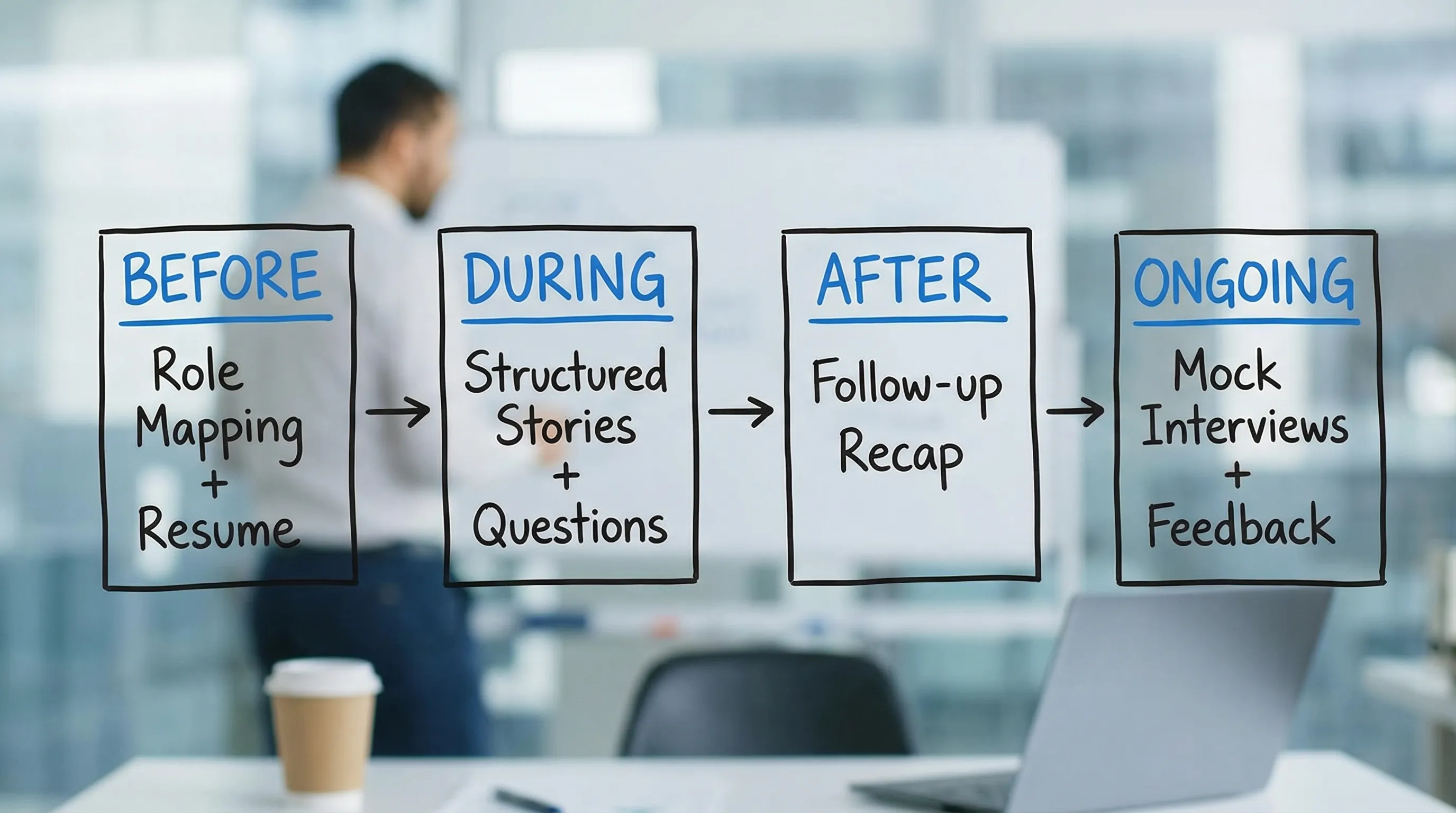
Send a recap + proof within 12 to 24 hours.
Keep it short.
Include:
- 1 line: gratitude
- 2 lines: what you understood about the role priorities
- 1 line: the proof you shared (or a link)
- 1 line: your interest and next step
This tactic is especially useful when you are applying through referrals, campus placements, or highly competitive roles.
“Do these tactics work for freshers, career switchers, and experienced candidates?”
Yes, but the emphasis changes.
“What should a fresher focus on?”
Freshers win with proof of work.
Even small proof counts.
Examples:
- A case study deck
- A mini project
- A volunteer outcome
- A simple portfolio
Pair this with resume writing tips so your proof is visible quickly.
“What should an experienced professional focus on?”
Experienced candidates win with scope and decision-making.
Show:
- How you prioritized
- How you influenced stakeholders
- How you handled trade-offs
“What should a career switcher focus on?”
Switchers win with transferable skills + a bridge plan.
Say:
“I know I’m switching from X to Y. Here’s the overlap, here’s what I’ve already built, and here’s what I’m learning next.”
“How can career counselling improve my interview outcomes?”
Interview performance improves fastest when you stop guessing what you are “good at” and start using evidence.
That is where career counselling Chennai and career counseling in Bangalore support can be practical, not motivational.
At ELYSIAN INSPIRES, candidates commonly work on:
- Strength and skill clarity using scientific assessments (including Multiple Intelligence-based assessment)
- Role mapping (what to apply for, what to skip)
- Mock interviews and feedback loops
- Profile building and CV writing
If you are exploring support options:
- For local guidance, see career counselling in Chennai.
- If you are based in Karnataka, explore career counselling in Bangalore.
- For flexibility, you can start with online career counselling in India.
Many families also ask how to choose the best career counsellor in Bangalore for interview and career direction support.
A simple filter is: assessment quality, structured plan, and measurable next steps.
“What are the key takeaways I should remember before my next interview?”
If you remember only a few job interview tips, remember these.
- Anchor your intro to the role, not your life story.
- Use STAR-IL, so your stories show growth and business impact.
- Ask funnel questions, then reflect what you understood.
- Turn weaknesses into controls, not apologies.
- Use resume writing tips, so your interview sounds consistent with your CV.
Frequently Asked Questions
What are hidden interview tactics to boost your hiring chances?
What are the best job interview tips for freshers in India?
How can career counselling Chennai help with interviews?
Is career counseling in Bangalore useful for working professionals?
What are quick resume writing tips that improve interview calls?
How do I follow up after an interview without sounding desperate?
