

How Can AI Support Students With Learning Disabilities?
How Can AI Support Students With Learning Disabilities?
AI supports students with learning disabilities by converting text to speech, speech to text, and adapting content and pacing in real time. These tools reduce cognitive load, improve access to reading, writing and math, and build independence at school and home.
- Key takeaways
- AI can personalize learning and offer on-demand supports like captions, summaries, and step-by-step hints.
- Use AI as assistive technology, not as a shortcut that replaces learning.
- Start with core needs: reading access, writing support, organization, and math scaffolds.
- Protect privacy, verify accuracy, and align with school accommodations.
What counts as a learning disability, and where can AI help first?
Specific learning disabilities typically include dyslexia (reading), dysgraphia (writing), and dyscalculia (math). Many students also face ADHD or autism-related learning challenges. AI cannot replace good teaching, but it can remove access barriers.
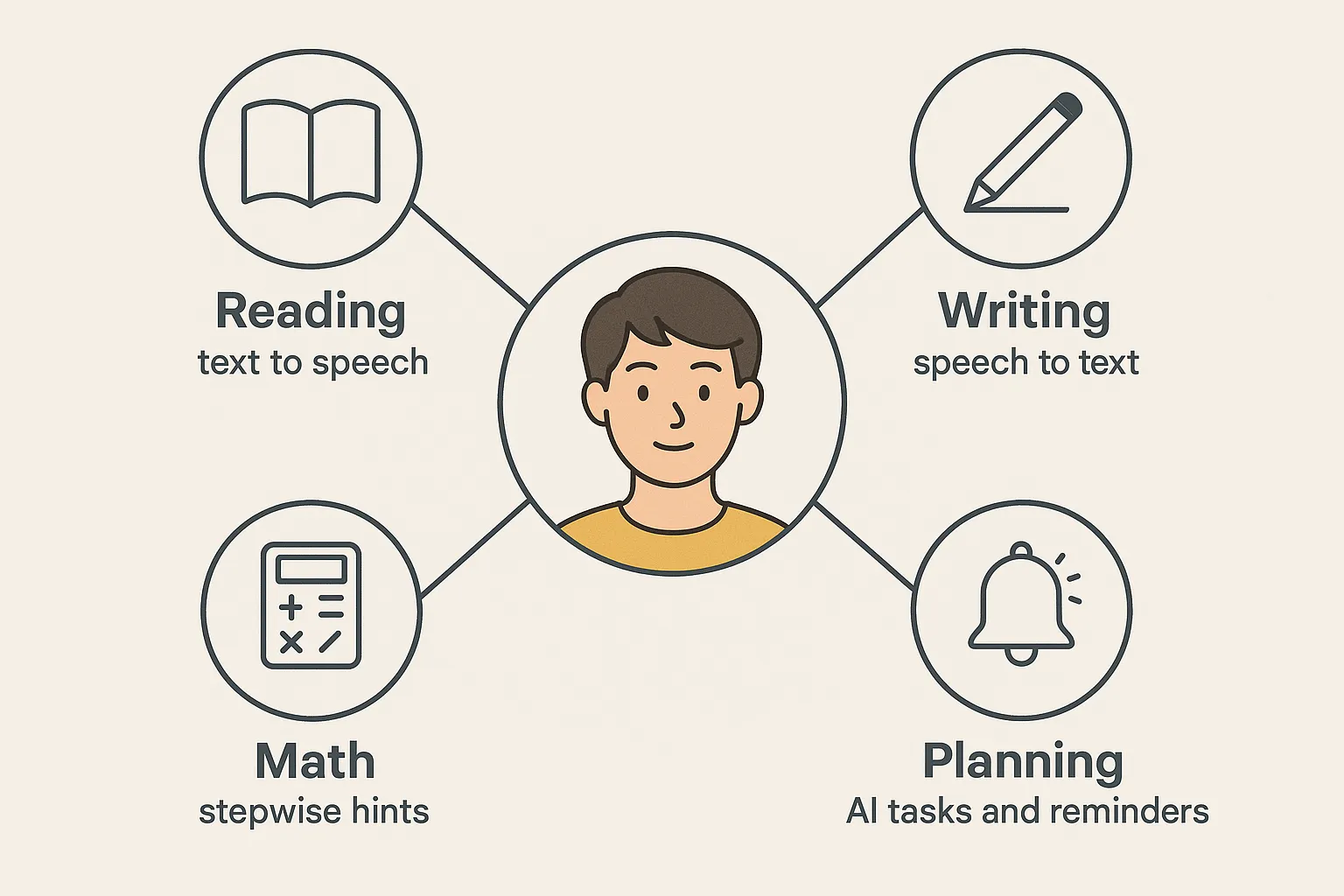
- Reading access, through text to speech and clean layouts
- Writing support, via speech to text and structured feedback
- Executive function, with planning, reminders, and chunking tasks
- Math understanding, through visual explanations and stepwise help
For context, inclusive education is a national priority in India under the NEP 2020 and CBSE’s accommodations for Children With Special Needs. See CBSE’s guidelines on CWSN accommodations and UNESCO’s guidance on AI in education.
How does AI make reading easier for students with dyslexia?
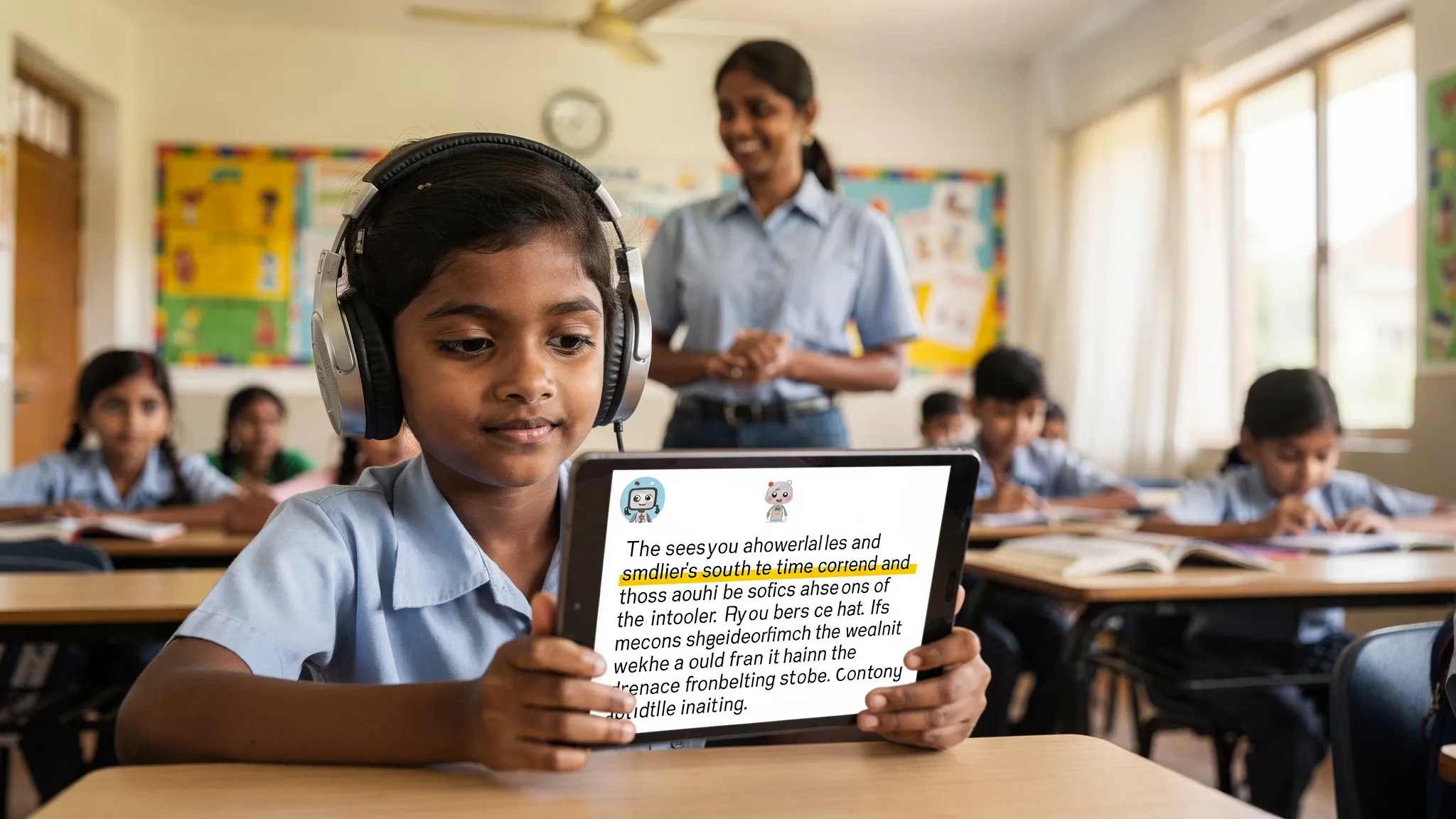
- Text to speech with synchronized highlighting, improves comprehension and reduces fatigue.
- Reading mode, cleans clutter, adjusts font size and spacing, and supports dyslexia-friendly fonts.
- Smart summaries and key-point extraction, offer previews of complex chapters.
- Vocabulary support, instant definitions, picture dictionaries, and translation.
Evidence-based frameworks like the UDL Guidelines by CAST/AEM Center support multiple means of representation, including text to speech.
Pros
- Immediate access to grade-level content
- Reduces decoding load and frustration
Cons
- Overuse of summaries can limit deep reading
- Quality varies by tool and subject domain
Can AI support writing for dysgraphia and ADHD?
Yes. Writing demands multiple skills: planning, composing, and editing. AI can scaffold each step.
- Speech to text, lets students dictate ideas quickly, reducing mechanical barriers.
- AI outlines, convert bullet notes into an ordered structure for essays.
- Grammar and clarity feedback, flags run-ons and suggests simpler phrasing.
- Templates and checklists, guide introductions, thesis statements, and conclusions.
Use AI ethically. Students should still generate ideas and evidence. AI can coach, not write entire assignments.
How does AI help with math and dyscalculia?
- Visual explanations, turn word problems into diagrams and number lines.
- Step-by-step hints, reveal the next step without giving the final answer immediately.
- Error diagnosis, identifies where a process broke down.
- Multimodal input, lets students upload a photo of a problem to receive hints.
Pros
- Reduces anxiety by breaking problems into small steps
- Encourages mastery through immediate feedback
Cons
- Risk of answer-harvesting without understanding
- Some tools struggle with multi-step geometry proofs
Will AI really help ADHD and executive function challenges?
Often, yes. Executive function is about managing time, tasks, and attention.
- Smart planners, convert a big project into daily micro-tasks with reminders.
- Focus modes, block distractions and set short work sprints with breaks.
- Priority prompts, help students choose the next best action.
- Visual timers and checklists, reduce procrastination and decision fatigue.
Pair these with teacher or parent check-ins to maintain accountability.
Can AI improve accessibility for hearing or speech differences?
- Live captions and transcripts, in classes and video lessons
- Real-time translation, for English and regional languages
- Voice banking or AAC suggestions, for students with speech differences
Accuracy varies with accents and background noise, so test in real classroom conditions.
Is AI better than traditional assistive technology?
Use them together. Traditional AT is stable and proven. AI adds personalization and speed.
| Support type | Best for | Typical AI example | Pros | Limits |
|---|---|---|---|---|
| Text to speech | Dyslexia, visual strain | AI voice with highlighting | Fast access to grade-level text | Voice quality and accuracy vary |
| Speech to text | Dysgraphia, motor issues | Real-time dictation | Speeds drafting, lowers barrier | Requires quiet space and training |
| Reading/mind maps | Planning, ADHD | AI outline and concept map | Structure ideas quickly | Can oversimplify nuance |
| Math hints | Dyscalculia, anxiety | Stepwise guidance | Encourages mastery | Temptation to copy answers |
| Captions/translation | Hearing differences, ELL | Live captions | Inclusive participation | Misses technical terms |
What are the risks, and how do we evaluate AI tools safely?
- Accuracy, check facts, especially in science and social studies.
- Bias, watch for stereotypes in generated examples.
- Privacy, review data collection and storage. India’s Digital Personal Data Protection Act 2023 sets expectations for consent and safeguards. See DPDP Act overview.
- Age appropriateness, ensure parent/guardian controls for minors.
- Alignment with accommodations, integrate with IEPs and CBSE rules.
A quick rubric
- Purpose fit, directly solves the student’s barrier
- Evidence, aligns with UDL and special education best practices
- Interoperability, works with school platforms and offline when needed
- Transparency, explains what data it uses and why
How should families choose the right tools in India?
- Start with a professional evaluation of strengths and needs.
- Agree on top three use cases, for example, reading access, note-making, and planning.
- Pilot one tool per use case for two weeks. Track time saved and grades or confidence.
- Review accessibility in Indian contexts, device affordability, language support, and limited bandwidth.
- Document ethical use, when AI is allowed or not for graded work.
If you are searching for the best career counsellor in India for inclusive planning, look for someone who understands assistive technology, exam accommodations, and local board policies.
How can Chennai schools integrate AI ethically and effectively?
- Build an inclusion policy, specify permitted uses per subject and grade.
- Train teachers, on text to speech, speech to text, and data privacy basics.
- Provide device access, headphones, microphones, and accessibility settings.
- Create AI checklists, make accommodations visible in lesson plans.
- Monitor outcomes, measure attendance, time on task, and comprehension gains.
Refer to UNESCO’s guidance on generative AI in education when writing policies and teacher training modules.
Where do career counsellors fit into this journey?
AI supports learning today, but students still need human guidance for subject choices, higher studies, and careers. That is where ELYSIAN INSPIRES comes in.
- Multiple Intelligence-based assessment, to map strengths and interests.
- Academic counselling for students and counselling for students after 12th, to select boards, streams, and degrees.
- Skill and goal identification, connecting classroom supports to future readiness.
- Guidance for higher studies and profile building, including CV writing and portfolios.
- Exam stress counselling, to manage pressure during board exams and entrance tests.
- Online counselling for career guidance, for families who prefer flexible sessions.
Explore career counselling in Chennai with personalized plans at ELYSIAN INSPIRES.
Can AI guide subject choices and skill based courses after Class 10 and 12?
Yes, with supervision. AI can suggest elective combinations, prerequisites, and emerging job roles.
- Map strengths to subjects, for example, strong visual reasoning toward design and architecture.
- Recommend skill based courses, like basic data analysis, design fundamentals, or coding for beginners.
- Generate college lists to discuss with a counsellor.
Use AI as a starting point. A certified counsellor validates choices, adds context about boards, cutoffs, and entrance exam timelines.
What do real-world examples look like?
- Middle school dyslexia, a student uses text to speech for science chapters and speech to text for lab reports. Grades improve as comprehension increases.
- Class 12 ADHD, a student breaks the board exam syllabus into daily tasks with an AI planner. Parent and teacher review weekly logs.
- Dyscalculia in commerce, a student uses stepwise hints and visual calculators for accounts. Meanwhile, the counsellor recommends skill based courses in spreadsheet literacy and financial modeling basics.
How much does it cost, and what devices work?
- Many reading and captioning tools are free or bundled with schools’ platforms.
- Premium tools offer better voices, note exports, and analytics.
- Low-end Android phones can run dictation and basic readers. Noise-cancelling headphones help in shared spaces.
Always test with your school network, typical classroom noise, and your child’s accents or language needs.
What are the pros and cons in one view?
Pros
- Personalization and on-demand support
- Faster access to content across subjects
- Builds independence and confidence
Cons
- Potential inaccuracy and bias
- Privacy considerations for minors
- Over-reliance can hide skill gaps if not monitored
What are smart ways to get started this week?
Day 1 to 2
- Identify top barriers: decoding, writing speed, organization, or math steps.
- Set one measurable goal, for example, reduce homework time by 20 percent.
Day 3 to 4
- Install one text to speech app and one speech to text app.
- Turn on captions for all video lessons.
Day 5 to 7
- Try an AI planner to split a project into micro-tasks.
- Review progress with a teacher or counsellor. Keep what works, remove what distracts.
How ELYSIAN INSPIRES supports inclusive learning and transitions
We combine scientific assessments with one-to-one guidance so families build a clear plan for school, exams, and careers.
- Personalized counselling sessions and academic counselling for students, matched to each learner’s profile.
- Stream and college selection, especially counselling for students after 12th.
- Linking classroom supports to future-ready pathways, including skill based courses your child can start now.
- Flexible sessions via online counselling for career guidance.
Ready to plan the next step? Book a personalized session with our Chennai counsellors at ELYSIAN INSPIRES.
What questions should families ask a career counselor about AI supports?
- How will AI tools align with my child’s IEP or CBSE accommodations?
- Which tools balance accessibility with academic integrity in our school?
- What data does each app collect, and how is consent handled under India’s DPDP Act?
- How do we measure success, grades, time saved, or confidence?
- Which skill based courses can my child start this term to build strengths?
- What are the best practices for using AI ethically in college applications?
If you are compiling questions to ask career counselor teams, bring a short demo of your child’s homework and test a tool together during the session.
Frequently Asked Questions
How can AI support students with learning disabilities?
Which AI tools help most with dyslexia?
Is using AI for homework considered cheating?
How do we keep student data safe when using AI?
Can AI recommend subjects and courses after Class 10 or 12?
Where can I get personalized guidance in Chennai?
our website.
