

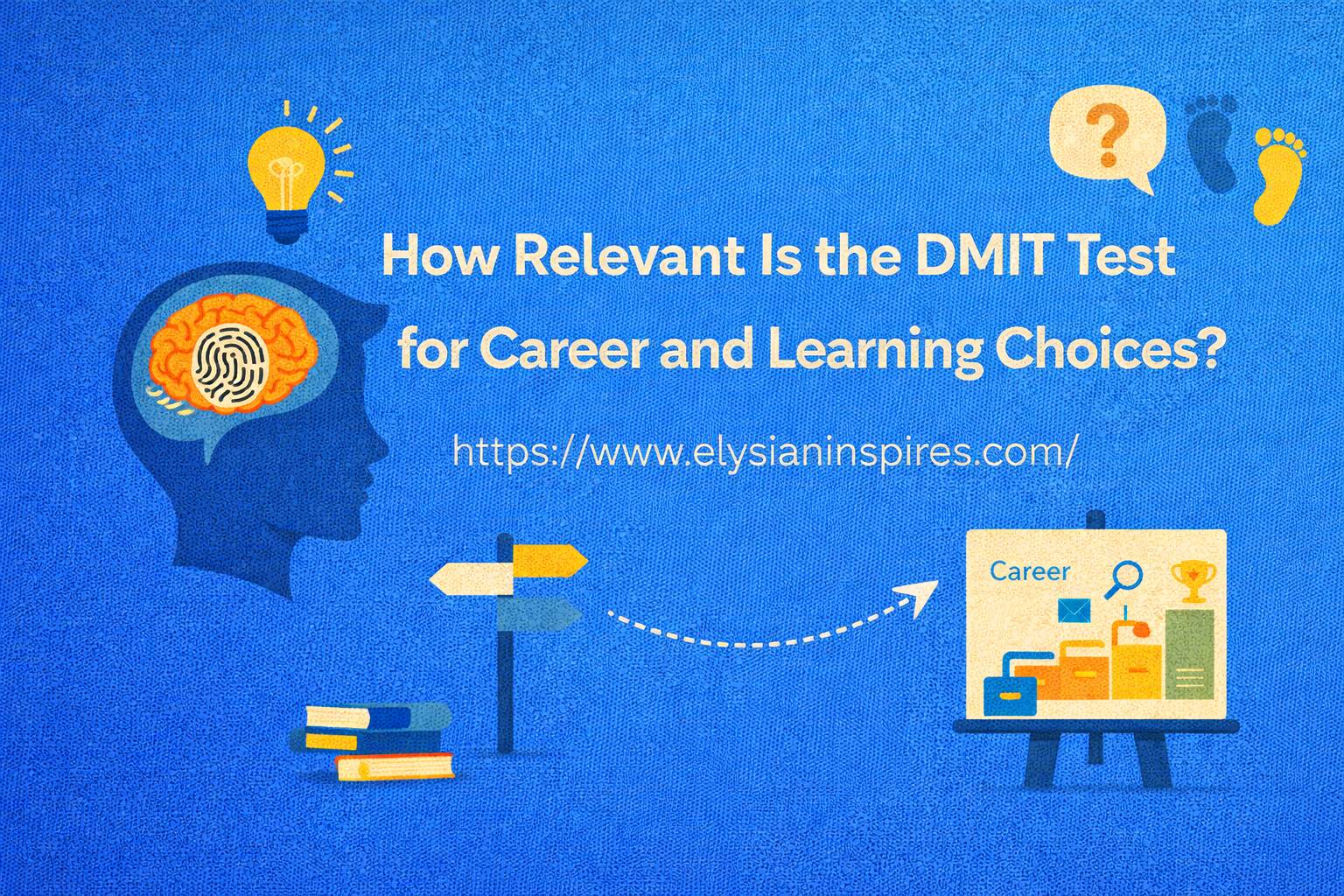
How Relevant Is the DMIT Test for Career and Learning Choices?
If you are asking, “How relevant is the DMIT Test for career and learning choices?” the most accurate answer is this: DMIT can be relevant as a self-awareness input (strengths, learning preferences, work-style clues), but it should not be treated as a final verdict. It works best when a qualified counsellor combines it with psychometric assessments, academic history, real-world exposure, and your goals.
What exactly is the DMIT Test, in simple terms?
The DMIT Test (Dermatoglyphics Multiple Intelligence Test) is an assessment that uses fingerprint patterns as one data source to map possible inborn tendencies related to learning and intelligence domains.
In practice, DMIT reports usually talk about:
- Multiple intelligence preferences (for example, logical, linguistic, spatial)
- Learning style tendencies (how you may learn faster)
- Behavioural inclinations (how you may approach tasks)
A helpful way to see it is: DMIT can start a conversation, it should not end it.
How relevant is the DMIT Test for career and learning choices?
Relevance depends on what decision you are trying to make and how you use the result.
DMIT is most relevant when you treat it like:
- A direction finder (broad suitability clues)
- A language tool (helps parents and students discuss strengths without blame)
- A learning strategy trigger (how to study better, not just what to study)
DMIT is less relevant when it is used like:
- A single “career predictor”
- A replacement for aptitude, interest, personality, and exposure
- A shortcut to avoid exploration
At ELYSIAN INSPIRES, we often see the best outcomes when DMIT insights are combined with personal career care, meaning the student or professional gets guidance that fits their context, constraints, and goals.
Which career and academic decisions can DMIT help with?
Here are realistic, high-value use cases where the DMIT Test can add clarity.
“I’m in Class 8 to 10, what should I focus on right now?”
DMIT can help identify where the student may feel naturally confident (for example, pattern thinking, language, spatial sense), so the next steps become clearer.
That can translate into:
- Better subject prioritisation
- Choosing the right extracurriculars
- Selecting skill-based courses that match the child’s energy and attention style
If you are exploring DMIT-based academic direction, you can also read ELYSIAN INSPIRES’ page on Academic counselling using DMIT in Chennai.
“After 10th, should I choose Science, Commerce, or Arts?”
This is one of the most common reasons families consider DMIT.
Used responsibly, DMIT can:
- Highlight learning strengths (for example, strong visual-spatial ability)
- Reduce confusion by narrowing to 2 to 4 realistic stream options
- Support a calmer parent-student discussion
But stream choice also needs academic performance, interest, and workload tolerance.
“After 12th, which course should I pick?”
This decision involves employability, college fit, and long-term motivation.
DMIT can support course selection by:
- Indicating preferred modes of learning (theory-heavy vs hands-on)
- Suggesting environments where you thrive (structured vs flexible)
Still, course choice should be cross-checked with aptitude and interest testing. A good starting point is understanding the broader category of tests in this guide on psychometric tests and career impact.
“My child studies hard but still struggles. Can DMIT help?”
Sometimes the issue is not effort, it is a mismatch between teaching style and learning style.
DMIT may help you experiment with:
- The best note-making method (mind maps vs linear notes)
- Revision format (practice tests vs rereading)
- Memory cues (visual anchors, stories, movement)
If stress is part of the picture, pairing learning strategy changes with emotional support can be important. ELYSIAN INSPIRES also offers counselling for exam stress.
What are the benefits of DMIT when used correctly?
When interpreted by a trained counsellor, DMIT can offer benefits that families and students often value.
- Faster self-understanding: Students get words for what feels easy or hard.
- Better learning choices: Study methods can be personalised instead of copied.
- Reduced conflict at home: Conversations move from “You are not trying” to “Let’s change the method.”
- Earlier exploration: Students can try aligned clubs, projects, and competitions sooner.
This is also where personal career care matters. A report is only useful if someone helps you translate it into daily actions.
What are the limitations (and red flags) you should know?
A practical and ethical DMIT conversation must include limitations.
“Can DMIT guarantee a career outcome?”
No. No assessment can guarantee a career outcome.
Your career success depends on:
- Skill-building and practice
- Mentorship and environment
- Opportunities and constraints
- Motivation and consistency
“Is DMIT alone enough to make a career choice?”
Not recommended.
If a provider claims DMIT is 100 percent accurate or that it can “prove” a specific profession, treat that as a red flag.
“What if DMIT results don’t match marks or interests?”
That is common, and it is not automatically a problem.
It can mean:
- The student has not had the right exposure yet
- Anxiety or exam stress is masking ability
- The student’s interest is stronger than their current skill
- Teaching methods are not aligned with learning preferences
A good counsellor will help you interpret mismatches without panic.
How does DMIT compare to psychometric and aptitude tests?
DMIT is often confused with standard psychometrics.
Here is a simple comparison to support better decision-making.
| Tool | What it mainly tells you | Best for | Watch-outs |
|---|---|---|---|
| DMIT | Possible innate tendencies and learning preferences | Learning strategy, early exploration | Should not be treated as a final career predictor |
| Psychometric tests | Interests, personality traits, behavioural preferences | Stream/course fit, role fit | Quality varies by test and interpretation |
| Aptitude tests | Current ability in logical, verbal, numerical domains | Competitive exam direction, skill-fit | Can be improved with training, so it is not “fixed” |
| Exposure trials | Real experience through projects, shadowing, internships | Reality check before committing | Needs planning and reflection |
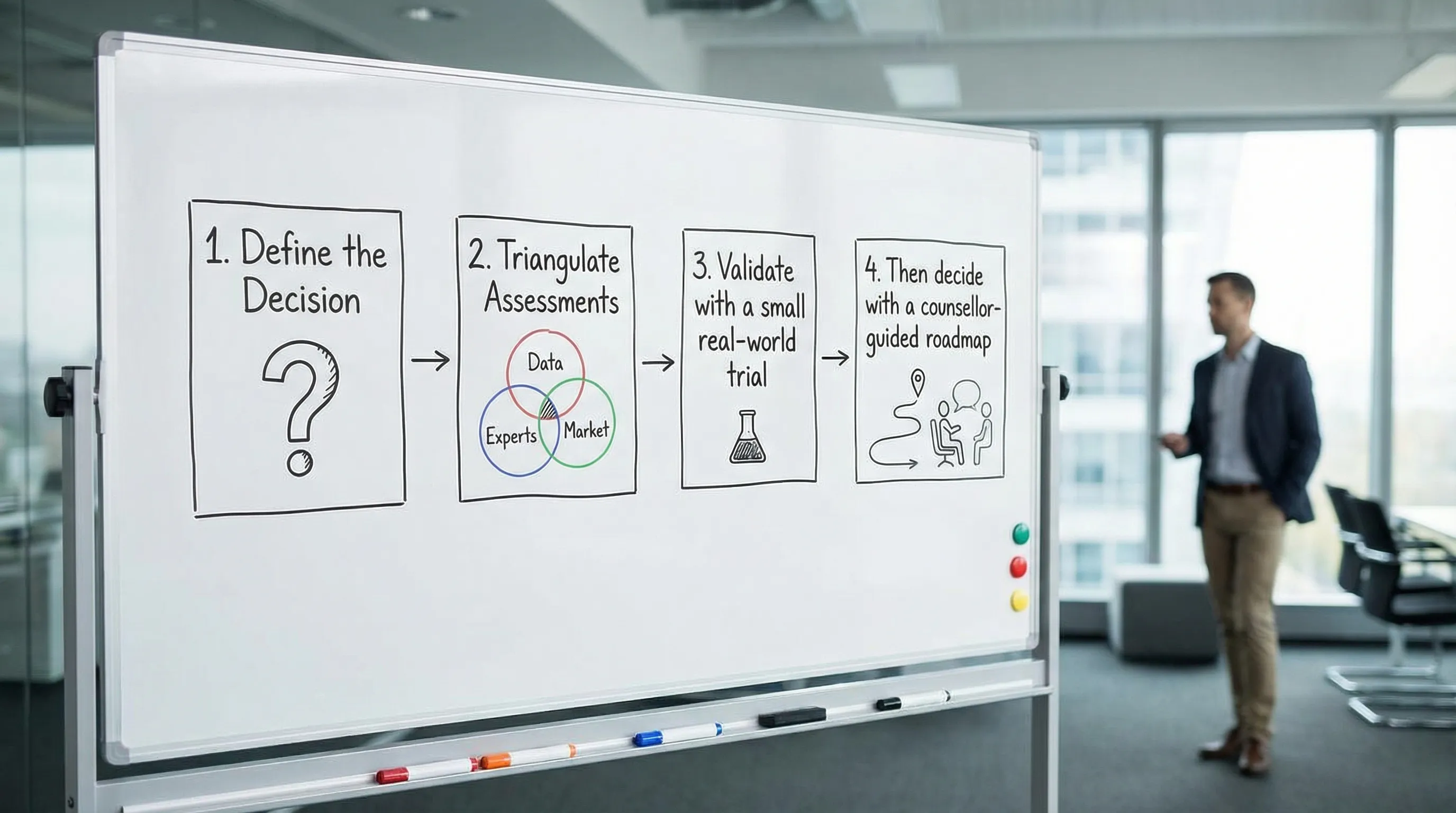
In ELYSIAN INSPIRES sessions, the most reliable approach is triangulation, meaning you compare DMIT-style insights with psychometrics, aptitude, and real-world evidence.
What is the best way to use DMIT results for real decisions?
Try this practical, parent-friendly method.
“What decision am I trying to make right now?”
Keep it specific.
Examples:
- Stream after 10th
- Course shortlist after 12th
- Specialisation choice in college
- Skill roadmap for a career switch
“What are 3 data points I can combine?”
Aim for at least three.
- DMIT insights
- Psychometric or aptitude test
- Academic history and teacher feedback
- A small trial (project, workshop, short course)
“What is my 30-day experiment?”
Instead of committing for 3 years based on one report, test a direction for 30 days.
For example:
- Interested in design? Do a beginner UI/UX project.
- Interested in coding? Build a small app or website.
- Interested in psychology? Volunteer, observe, and journal what energises you.
This is where personal career care becomes practical, the counsellor helps you choose experiments that match your stage and capacity.
Can DMIT improve learning choices and study methods?
Yes, this is one of the most useful and low-risk applications.
“What does ‘learning style’ mean in everyday student life?”
It affects how you:
- Take notes
- Revise
- Remember and recall in exams
- Stay focused during long study hours
“What are examples of learning strategy changes?”
If your profile suggests stronger visual learning, you may do better with:
- Flowcharts and mind maps
- Colour-coded notes (used lightly)
- Diagrams and spatial memory cues
If your profile suggests stronger kinesthetic tendencies, you may do better with:
- Solving by writing (not just reading)
- Teaching someone else
- Using timed practice and active recall
The key is to test strategies and track marks and stress levels, not just assume.
Is DMIT relevant for working professionals too?
It can be, especially if you use it for learning and upskilling choices, not as a “career destiny” report.
“When does DMIT help a professional?”
- When you keep switching roles and cannot explain what fits
- When you want to know which learning mode helps you upskill faster
- When you feel stuck and need structure to evaluate options
“What else should professionals combine with DMIT?”
- Skills inventory and role requirements
- Market reality (job demand, salary bands, entry barriers)
- Portfolio proof (projects, certifications, case studies)
For structured support, explore Professional career counselling in Chennai.
How do I choose a trustworthy DMIT and counselling provider?
Use these checks before booking.
- The provider clearly explains limitations and avoids absolute promises.
- You receive interpretation through a counselling session, not just a report.
- The process includes goal setting and an action plan.
- Your privacy and data handling are explained.
If you want flexibility, ELYSIAN INSPIRES also offers online counselling for career guidance that helps you interpret results and build a roadmap from anywhere in India. You can start here: Best online career counselling in India.
How does ELYSIAN INSPIRES approach DMIT-based guidance?
At ELYSIAN INSPIRES, DMIT is treated as one piece of a larger puzzle.
A typical responsible approach includes:
- Understanding the student or professional’s context and constraints
- Using assessments (including the DMIT Test where appropriate)
- Mapping strengths, interests, goals, and skill gaps
- Creating a realistic next-steps plan (courses, projects, stream or role shortlist)
This is especially valuable for families looking for career counseling chennai services with a personalised approach.
If you are ready to speak to a counsellor, you can contact the team via Online career counselor contact number. If you prefer remote sessions, online counselling for career guidance can be scheduled around school and work timings.
Quick takeaways (for zero-click clarity)
- How relevant is the DMIT Test for career and learning choices? Relevant as a supporting input, not as a final decision-maker.
- DMIT is strongest for learning strategy and early exploration.
- Combine DMIT with psychometrics, aptitude, marks history, and real-world trials.
- Choose providers who explain limitations and offer guided interpretation.
- For career counseling chennai (and remote support), structured sessions matter more than the test alone.
Frequently Asked Questions
Is the DMIT Test accurate enough to choose a career?
How can DMIT help with learning choices?
Who benefits the most from DMIT-based counselling?
What should I combine with DMIT for better career decisions?
Can I take DMIT counselling online?
How do I find career counseling Chennai with a personalized approach?
