


How Should a 2nd-Year Civil Engineering Student Start Preparing for GATE?
If you’re asking “How Should a 2nd-Year Civil Engineering Student Start Preparing for GATE?”, the best answer is: build fundamentals now, start light but consistent practice, and create a semester-wise plan that gradually shifts from concepts to previous-year problems and full mocks. Second year is early enough to prepare without burnout, and late enough to be serious. career consultant Chennai
Is 2nd year too early to start GATE preparation for Civil Engineering?
No, 2nd year is actually the safest start.
You still have time to strengthen basics, make mistakes, and fix your weak areas before the “panic phase” of final year.
For a Civil Engineering Student Start Preparing for GATE, the biggest advantage of 2nd year is that your college subjects and GATE syllabus overlap heavily.
Quick takeaway
- Early start reduces stress and last-minute coaching dependency.
- You can align internships, projects, and electives with GATE goals.
- You get time for career plannig (and you avoid random decision-making).
What should I know first about the GATE exam as a Civil student?
Start with clarity on the exam structure and what it tests.
GATE is not only about memorising formulas.
It rewards concept clarity, exam temperament, and consistent problem-solving.
What does GATE really test?
GATE mainly checks:
- Conceptual understanding (why a formula works)
- Numerical ability under time pressure
- Accuracy, not just speed
- Strength in core subjects plus Engineering Mathematics
Where should I confirm syllabus and rules?
Always treat the official portal as the final reference.
Check the GATE official website for the latest syllabus, paper pattern, and eligibility updates.
Which subjects should a 2nd-year Civil Engineering student prioritise first?
Start with subjects that build your base for multiple topics.
This makes your later preparation faster.
A Civil Engineering Student Start Preparing for GATE should usually prioritise “foundation-first” subjects, not “trendy high-scoring” shortcuts.
Here’s a safe priority map most students benefit from.
| Priority | Subject group | Why it should come early | What to focus on first |
|---|---|---|---|
| 1 | Engineering Mathematics | Useful across sections, improves accuracy | Calculus basics, linear algebra basics, probability basics |
| 2 | Strength of Materials + Structural Analysis basics | Supports design and analysis thinking | Free body diagrams, SFD/BMD, stress-strain, Mohr’s circle |
| 3 | Fluid Mechanics basics | High concept density, needs time | Bernoulli, continuity, momentum equation |
| 4 | Geotechnical basics | Concept + memory blend | Soil properties, effective stress, shear strength |
| 5 | Environmental + Transportation (later) | Easier to strengthen once base is strong | Core definitions, standard numericals, typical graphs |
How many hours per week should I study in 2nd year for GATE?
Think “minimum effective dose”, not extreme schedules.
In 2nd year, 6 to 10 focused hours per week is enough for most students.
If you have heavy college workload, even 4 to 6 hours/week, done consistently, beats random 12-hour bursts.
A simple weekly split that works
- 3 to 4 sessions per week
- 60 to 90 minutes per session
- One short revision slot on weekends
How do I make a semester-wise plan from 2nd year to final year?
This is where most students either win or waste time.
Your plan should match your college semesters.
Here’s a practical roadmap for How Should a 2nd-Year Civil Engineering Student Start Preparing for GATE? without burning out.
| Time period | Main goal | What you should do (simple and realistic) | Output you must have |
|---|---|---|---|
| 2nd year (Sem 3–4) | Fundamentals | Build notes, solve basic numericals, fix concept gaps | Clean formula book + error log begins |
| 3rd year (Sem 5) | Strength + speed | Start topic-wise PYQs, improve time and accuracy | Subject-wise PYQ notebook |
| 3rd year (Sem 6) | Integration | Mixed practice sets, strengthen weak subjects | 1 revision cycle complete |
| Final year (Sem 7) | Exam mode | Full-length mocks, revise, improve exam strategy | Mock-analysis tracker |
| Final year (Sem 8) | Peak performance | Only revision, PYQs, test series, and calmness | Consistent scores + low silly mistakes |
How should I study a subject so that it actually sticks?
Most students “cover” topics, but don’t retain.
Use a cycle: Learn → Practice → Recall → Fix mistakes → Repeat.
One reason toppers look “naturally smart” is they revise scientifically.
If you want a research-backed method, strategies like practice testing and spaced repetition are strongly supported in learning science (for example, see Dunlosky et al., 2013 in Psychological Science in the Public Interest).
What is a simple 2-page note rule?
For every topic, force yourself to create:
- 1 page concepts (definitions, assumptions)
- 1 page formulas + 5 standard question types
Short notes are easier to revise.
They also reduce anxiety.
When should I start solving previous-year questions (PYQs)?
Start earlier than you think, but in the correct way.
In 2nd year, you can start PYQs after finishing a topic’s basics.
Don’t treat PYQs as an “end of syllabus” activity.
How many PYQs are enough in 2nd year?
A realistic target:
- 15 to 25 PYQs per topic (not per subject)
- Focus on understanding the pattern
- Add every mistake to your error log
Should I join coaching in 2nd year or wait?
Coaching can help, but it is not always necessary in 2nd year.
A better question is: do you need structure or do you need teaching?
Self-study vs coaching in 2nd year (quick comparison)
| Option | Pros | Cons | Best for |
|---|---|---|---|
| Self-study | Flexible, low cost, builds independence | Easy to lose direction | Disciplined students with good college support |
| Coaching | Structured plan, doubt clearing, peer pressure helps | Can become passive learning | Students who need routine and accountability |
If you choose coaching, still keep your own notes.
GATE rewards understanding, not copied material.
What resources should I use for GATE Civil in 2nd year?
Keep it simple.
Too many books and channels create confusion.
What are safe, credible resource types?
- Standard college textbooks for concepts
- One consistent lecture source like NPTEL for difficult topics
- PYQs as your primary practice material
Your goal is not to collect resources.
Your goal is to solve questions with confidence.
What mistakes do 2nd-year students make while preparing for GATE?
Most mistakes are not about intelligence.
They are about planning and habits.
Here are the big ones (and how to fix them).
- Mistake: Starting with random “high weightage” topics. Fix: Start with fundamentals and build upward.
- Mistake: Watching lectures without solving problems. Fix: 70% practice, 30% input.
- Mistake: No revision system. Fix: weekly revision + monthly mini-tests.
- Mistake: Ignoring mental stamina. Fix: small consistent sessions beat extreme schedules.
This is also where career plannig matters.
When you know your target (PSU, MTech, research), your preparation becomes more focused.
What are the benefits of starting in 2nd year (besides rank)?
Rank is not the only benefit.
Starting early improves your overall engineering profile.
You gain
- Better understanding in college exams
- Stronger base for internships and projects
- Confidence in technical interviews
- A clearer path for career plannig (instead of confusion in final year)
Should I do skill based courses along with GATE preparation?
Yes, if you do it strategically.
Skill based courses improve employability and help you test your interest in real-world civil work.
They also give you a backup plan.
For many students, combining GATE with skill based courses reduces anxiety because you are not “betting everything on one exam”.
Which skill based courses are practical for Civil students?
Choose based on the path you want.
- Design/structural tools (for private sector design roles)
- Planning tools (for site/project roles)
- Data + basics (for analytics-minded civil roles)
Do not overload.
Pick one skill, build proof, then move to the next.
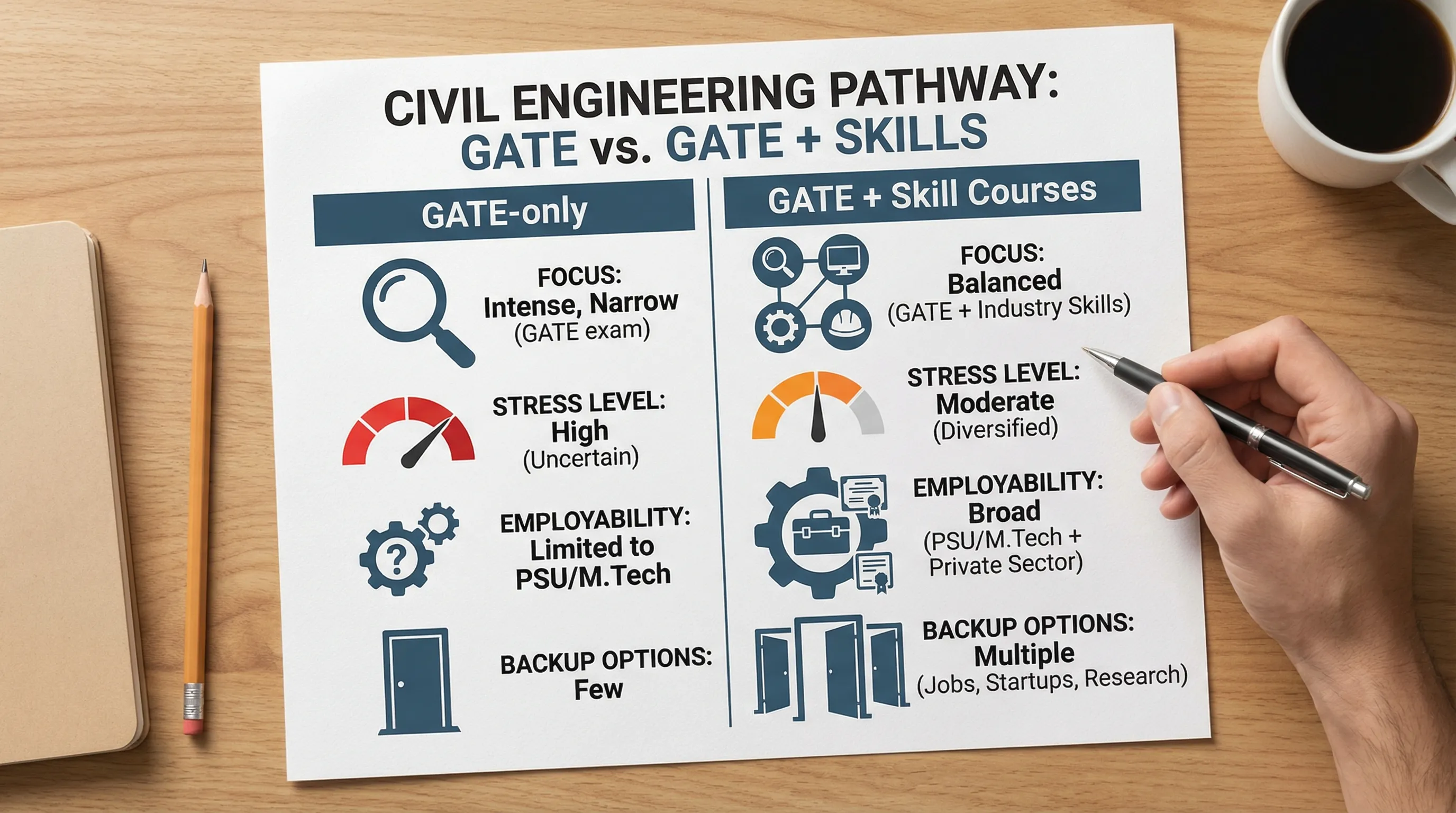
GATE-only vs GATE + skill courses (pros and cons)
| Route | Pros | Cons | Best fit |
|---|---|---|---|
| Only GATE | Maximum focus, faster syllabus coverage | Higher emotional pressure, fewer backups | Students 100% sure about PSU/MTech |
| GATE + skill based courses | Stronger resume, backup options, better clarity | Needs time management | Students who want both exam + employability |
A smart Civil Engineering Student Start Preparing for GATE strategy is to keep one light skill track running in parallel.
Can internships and projects help my GATE preparation?
Yes, if you choose them thoughtfully.
Projects build engineering intuition.
That intuition helps you solve tricky conceptual questions.
What is a good example of a “GATE-aligned” project?
A simple example:
- A mini project that includes surveying, estimation, and basic structural checks
Even if your project is not directly in the GATE syllabus, it improves problem thinking.
That is valuable.
What if I’m preparing for GATE but I’m not sure about my long-term career?
This is more common than people admit.
Many students start GATE because friends are doing it.
That is risky.
If you’re unclear, you need structured exploration, not guesswork.
This is exactly where best career counselling makes a difference.
At ELYSIAN INSPIRES, career guidance is built around scientific assessments and personalised sessions, so you can connect your strengths to the right path.
If you want a structured approach, explore:
- Career counselling for college students
- Professional career counselling in Chennai
- Best online career counselling in India
A good counsellor does not just “motivate”.
They help you build a realistic plan.
That is why students search for best career counselling when they feel stuck between PSU dreams, MTech options, and private jobs.
How can assessments help a GATE aspirant in 2nd year?
Assessments don’t replace study.
They improve decision-making.
They help you understand:
- Your learning style
- Your natural strengths
- Your stress triggers and productivity patterns
For example, ELYSIAN INSPIRES offers strengths-focused tools like:
This can be useful when you are choosing whether to go “GATE-heavy” or balance GATE with internships and skill based courses.
How do I manage stress while preparing for GATE alongside college?
Stress is not a weakness.
It is a signal that your system needs adjustment.
Start with small changes:
- Short daily movement (walk, stretch)
- Sleep consistency
- Weekly planning (not daily panic)
If anxiety is affecting your preparation, consider support.
ELYSIAN INSPIRES also provides counselling for exam stress, including online sessions.
If I’m preparing for GATE, do I also need resume and profile building?
If you want strong backups, yes.
Even serious GATE aspirants apply for internships, project roles, or jobs as plan B.
Your profile should not be empty.
A good starting point is learning how to present projects and skills clearly.
You can use ELYSIAN INSPIRES resources like:
How do I get personalised guidance from ELYSIAN INSPIRES for my GATE + career plan?
If you want personalised planning, you can take an online session.
This is helpful if you are balancing college, GATE, internships, and family expectations.
For bookings and direct contact, refer to:
That guidance can cover:
- Study roadmap
- Strength and skill-gap mapping
- Course selection (including skill based courses)
- Long-term career plannig
What is a realistic “next 7 days” action plan for a 2nd-year Civil student?
Keep the plan simple.
Consistency beats intensity.
- Choose 1 subject to start (Math or SOM are safe picks)
- Study concepts for 60 to 90 minutes, 3 to 4 times this week
- Solve 25 to 40 mixed basics (not full mock)
- Create an error log (a simple notebook is enough)
- Decide one small skill track (optional) from skill based courses
This is how a Civil Engineering Student Start Preparing for GATE without overwhelm.
Frequently Asked Questions
How Should a 2nd-Year Civil Engineering Student Start Preparing for GATE?
Is it too early to start GATE preparation in 2nd year for Civil Engineering?
How many hours should a 2nd-year Civil student study for GATE per week?
When should I start previous-year questions for GATE CE?
Should I do skill based courses along with GATE preparation?
Do I need career counselling if I’m preparing for GATE?
Can online career counselling help a GATE aspirant in Chennai?
How do I manage exam stress while preparing for GATE and college exams together?
