

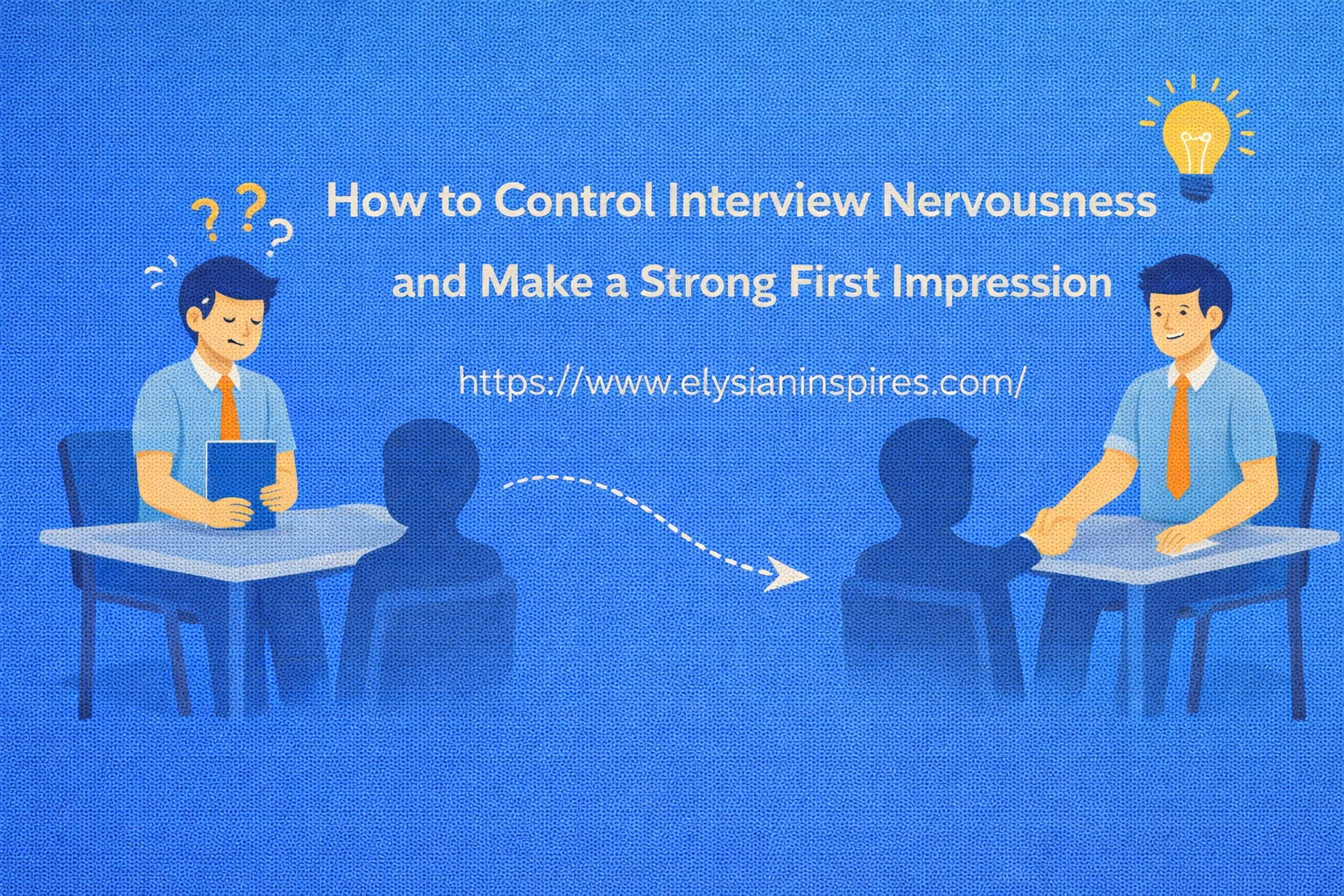
How to Control Interview Nervousness and Make a Strong First Impression
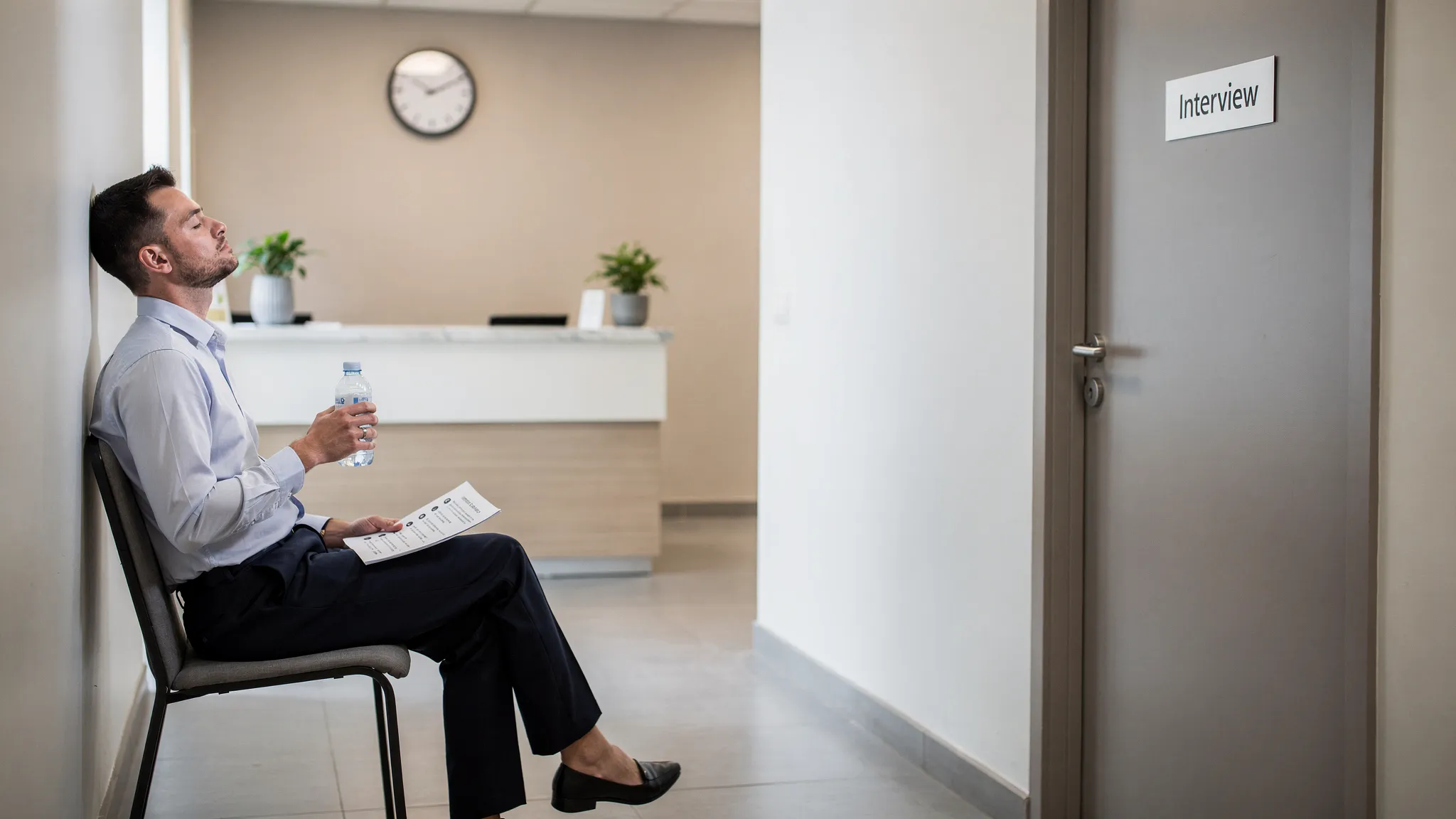
Interview nervousness is a normal stress response, but you can control it by reducing uncertainty (clear prep), calming your body (breathing and posture), and using simple answer structures so you never “blank”, all while showing confident, respectful energy in the first 60 seconds. Interview Prepration Tips
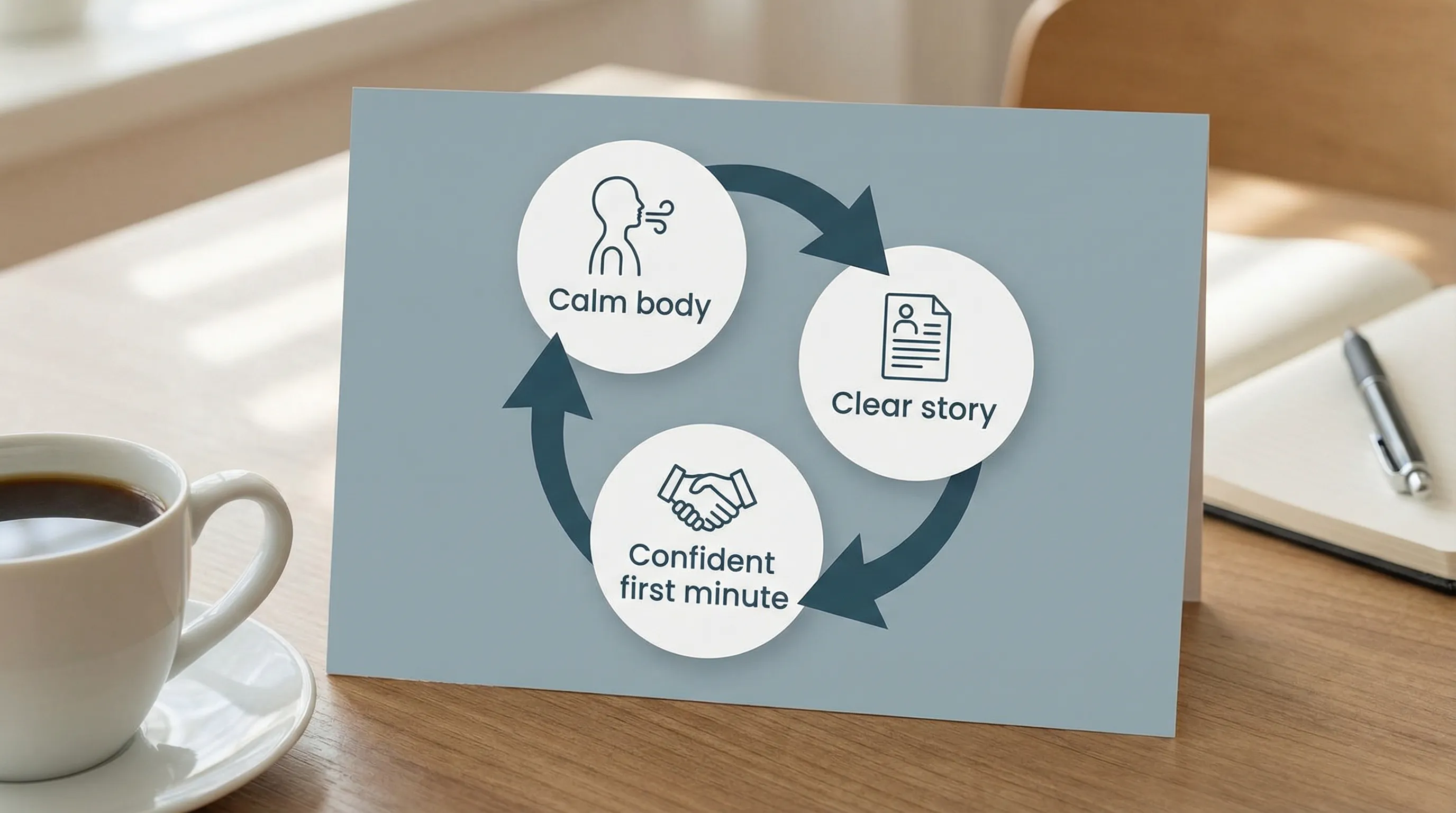
If your goal is to Control Interview Nervousness and make a strong first impression, focus on three things: preparation you can prove, a short calming routine, and a crisp opening introduction.
What are the quickest takeaways if I’m short on time?
- Your nervousness is not the enemy, unpreparedness is.
- First impressions form fast, so your first minute matters more than you think.
- Use a 60-second intro + 6 STAR stories + 5 smart questions.
- Your resume should do “half the talking”, follow strong resume writing tips so you can speak with proof.
- Build confidence through practice, feedback, and small daily personality development habits.
Why do I feel so nervous before an interview even when I’m qualified?
Because interviews trigger uncertainty and evaluation.
Your brain reads it as “high stakes”, and your body responds with a faster heartbeat, dry mouth, and racing thoughts.
Also, nervousness often increases when you do not know what the interviewer will ask, or how you will answer.
A helpful reframe is: nervousness is energy.
Your job is to direct that energy into structure and clarity.
If you want to understand how fast people form impressions, research shows first impressions can form within milliseconds in many contexts (for example, rapid trait judgments) as discussed in classic work by Willis and Todorov (2006) in Psychological Science.
How do I control interview nervousness in 10 minutes right before I enter?
Use this 10-minute routine to Control Interview Nervousness without overthinking.
Can you give me a simple 10-minute routine (minute-by-minute)?
Minute 1 to 2: breathing reset
Try box breathing: inhale 4, hold 4, exhale 4, hold 4.
Keep shoulders relaxed and jaw unclenched.
Minute 3 to 5: posture and voice warm-up
Stand tall, roll shoulders back once, and release your hands.
Quietly read your introduction once, focusing on slow pace.
Minute 6 to 8: “proof scan”
Open your resume and pick two achievements you can explain in 20 seconds each.
This reduces uncertainty fast, especially if your resume is strong.
Minute 9 to 10: cue sentence
Say one sentence to yourself: “I don’t need to be perfect, I need to be clear.”
That mindset shift supports personality development over performance pressure.
What should I do 24 hours before the interview to feel confident?
Think of the day before as “confidence engineering”.
You are building predictability so your brain stops imagining worst-case scenarios.
What should I prepare so I don’t panic during questions?
Prepare these four items:
- A 60-second self-introduction
- 6 achievement stories using STAR (Situation, Task, Action, Result)
- 3 role-fit reasons (why this role, why this company, why now)
- 5 questions to ask the interviewer
This set alone covers a large percentage of real interviews and is a practical set of interview tips.
What should I pack the night before?
Keep it simple.
Carry a printed resume, a notebook, a pen, and any requested documents.
For online interviews, test your laptop camera, microphone, lighting, and internet.
How do I make a strong first impression in the first 60 seconds?
A strong first impression is clarity plus warmth.
You want the interviewer to quickly feel: “This person is prepared, calm, and easy to work with.”
What should I say when they ask “Tell me about yourself?”
Use this 4-line structure:
- Present: who you are now (role or student status)
- Past: one relevant strength-building experience
- Proof: 1 achievement with outcome
- Purpose: why you are here (role alignment)
Example (fresher):
“I’m a final-year B.Com student focused on analytics and reporting. Over the last year I built strong Excel and basic Power BI skills through projects. In my college project, I cleaned and analyzed sales data and presented insights that improved the team’s recommendations. Now I’m looking for an entry-level analyst role where I can apply these skills and grow.”
This is one of the most reliable interview tips because it reduces rambling.
What should I do with my body language when I enter?
Aim for “calm confidence”, not stiffness.
- Make eye contact for 2 to 3 seconds
- Smile gently
- Sit only after you are invited
- Keep both feet grounded
Here is a quick “first minute” cheat sheet:
| First 60 seconds element | Do this | Avoid this |
|---|---|---|
| Greeting | “Good morning, thank you for having me.” | Apologizing, over-explaining traffic, blaming |
| Posture | Upright, shoulders relaxed | Slouching, gripping bag, fidgeting |
| Pace | Slightly slower than normal | Speed-talking |
| Introduction | 45 to 75 seconds, proof-based | Full life story |
What if my mind goes blank during the interview?
Blanking happens when stress blocks recall.
The fix is to stop “searching your memory” and start using structure.
What can I say to buy time without looking weak?
Use one of these bridging lines:
- “That’s a good question. Let me think for a moment.”
- “Before I answer, may I confirm if you mean X or Y?”
- “I’ll answer with an example from my last project.”
Then immediately move into STAR.
How do I answer behavioral questions without panicking?
Prepare 6 STAR stories that you can reuse.
Your stories can cover teamwork, conflict, leadership, failure, pressure, and learning.
If you want a deeper guide on common HR questions and answer frameworks, you can also read ELYSIAN INSPIRES’ post on HR interview questions to prepare.
How can my resume reduce interview anxiety (and improve first impression)?
A clear resume reduces anxiety because it gives you a “script of proof”.
When your points are outcome-based, you can speak from facts, not feelings.
This is why following resume writing tips is not just about getting shortlisted, it is also about staying calm once you are in the room.
What are the best resume tweaks to feel more confident while speaking?
Focus on these three:
- Turn responsibilities into outcomes (what changed because of you)
- Add numbers where honest and relevant (time saved, accuracy improved, size of event)
- Align your top third of the resume to the job description
If you want a full step-by-step reference, start with ELYSIAN INSPIRES’ guide on Resume Writing Tips.
What are the pros and cons of using a “one-size-fits-all” resume?
Pros
It saves time.
Cons
It increases interview nervousness because your resume does not match the questions.
You end up improvising, which makes it harder to Control Interview Nervousness.
A tailored resume supports tailored answers, and that improves your first impression.
Which interview preparation approach works best: memorizing answers or using frameworks?
Frameworks win in real interviews.
Memorizing sounds perfect in your head, but breaks under pressure.
Quick comparison: memorized script vs structured talking points
| Approach | Works well when | Risk under stress | Best use |
|---|---|---|---|
| Memorized answers | Questions are predictable | You freeze if question changes | Only for intro, key definitions |
| Frameworks (STAR, 3-part) | Interview is dynamic | Needs practice to be natural | Most HR and behavioral questions |
This is a practical set of interview tips for both freshers and experienced professionals.
How do I sound confident even if I’m nervous inside?
Confidence is often “audible”, not emotional.
Even if your heart is racing, you can still sound calm.
What voice habits create a strong first impression?
- Pause before answering
- Speak slightly slower than your normal speed
- End sentences with a downward tone (not like a question)
What should I do with my hands?
Keep them visible and relaxed.
If you are online, keep your hands mostly below the camera frame, and use small gestures.
How does personality development help in interviews (practically, not motivationally)?
personality development helps you show steady behavior under pressure.
It improves your self-awareness, communication habits, and emotional control.
In interviews, that shows up as:
- Better listening
- Less defensive answers
- Clearer stories
- More professional presence
If you want scientific self-awareness tools, ELYSIAN INSPIRES also offers a Multiple Intelligence-based assessment that can support strength discovery and better career positioning.
Can mock interviews really reduce nervousness, or is it just “practice for practice sake”?
Mock interviews reduce nervousness when the feedback is specific.
You are training your brain that “this situation is survivable”, and you are improving your answers.
To go deeper, you can read ELYSIAN INSPIRES’ post on how mock interviews help in campus placements.
What are the pros and cons of mock interviews?
Pros
You learn your filler words, weak stories, and body language.
You build speed and structure, which helps Control Interview Nervousness.
Cons
Low-quality mocks (no feedback) can waste time.
If you do too many mocks without fixing basics (resume and stories), you may feel stuck.
What are common mistakes that ruin a first impression (even with good skills)?
Many candidates fail due to avoidable signals.
These are not “talent problems”, they are presentation problems.
Common mistakes:
- Arriving late and starting with excuses
- Speaking too fast and not pausing
- Giving vague answers without proof
- Criticizing previous managers or colleges
- Not knowing basic details about the role
Fixing these is both personality development and execution.
How should online interviews change my nervousness-control strategy?
Online interviews add “tech stress” and reduce natural connection.
So you must prepare your environment.
What are quick online interview fixes that improve first impression?
- Place the camera at eye level
- Look at the camera while speaking key lines
- Use a simple, clean background
- Keep a glass of water nearby
Keep a one-page cheat sheet on the desk.
But do not read from it, use it only for keywords.
How do I handle interview nervousness as a fresher vs an experienced professional?
Freshers fear “lack of experience”.
Experienced candidates fear “being judged for choices”.
If I’m a fresher, what proof should I talk about?
Use projects, internships, volunteering, college events, and certifications.
Tie them to outcomes.
If I’m experienced, what should I prioritize?
Prioritize impact, scope, and decision-making.
Also prepare a clean reason for change.
If you are returning after a break, ELYSIAN INSPIRES also has a helpful guide on preparing for interviews after a gap.
I’m applying as a teacher. Any specific guidance for answering teacher interview questions?
Yes, answering teacher interview questions is a special case because schools assess both competence and classroom presence.
They look for clarity, calm authority, and student centre thinking.
What teacher interview questions cause the most nervousness?
Usually these:
- “How do you manage a disruptive class?”
- “How do you handle slow learners and advanced learners together?”
- “What is your teaching philosophy?”
- “How do you communicate with parents?”
What is a strong structure for teacher answers?
Use “Approach + Example + Result”.
Example:
“My approach is setting clear expectations and using consistent consequences. In my last class, I used seating changes and positive reinforcement for a student who interrupted frequently. Within two weeks, interruptions reduced and the student participated more productively.”
This structure keeps you calm and is aligned with practical interview tips.
When should I seek professional support from a career counsellor?
Seek support when nervousness is blocking performance, not when it is just mild butterflies.
You might benefit from guidance if:
- You are getting rejected repeatedly despite being qualified
- You struggle to communicate your strengths
- Your resume is not getting shortlisted
- You need structured practice and feedback
ELYSIAN INSPIRES provides personalized career and academic counselling in Chennai, including interview readiness, profile building, and scientific assessments.
You can start with their Job Interview Tips resource and then book a personalized session through Elysian Inspires.
Frequently Asked Questions
How can I control interview nervousness quickly?
What makes a strong first impression in an interview?
What should I say in the first 60 seconds of an interview?
How do I stop going blank during interview questions?
How do resume writing tips help in interviews?
Do mock interviews really help reduce nervousness?
What are the best tips for answering teacher interview questions?
