


How to Stay Motivated After Repeated Job or Research Rejections
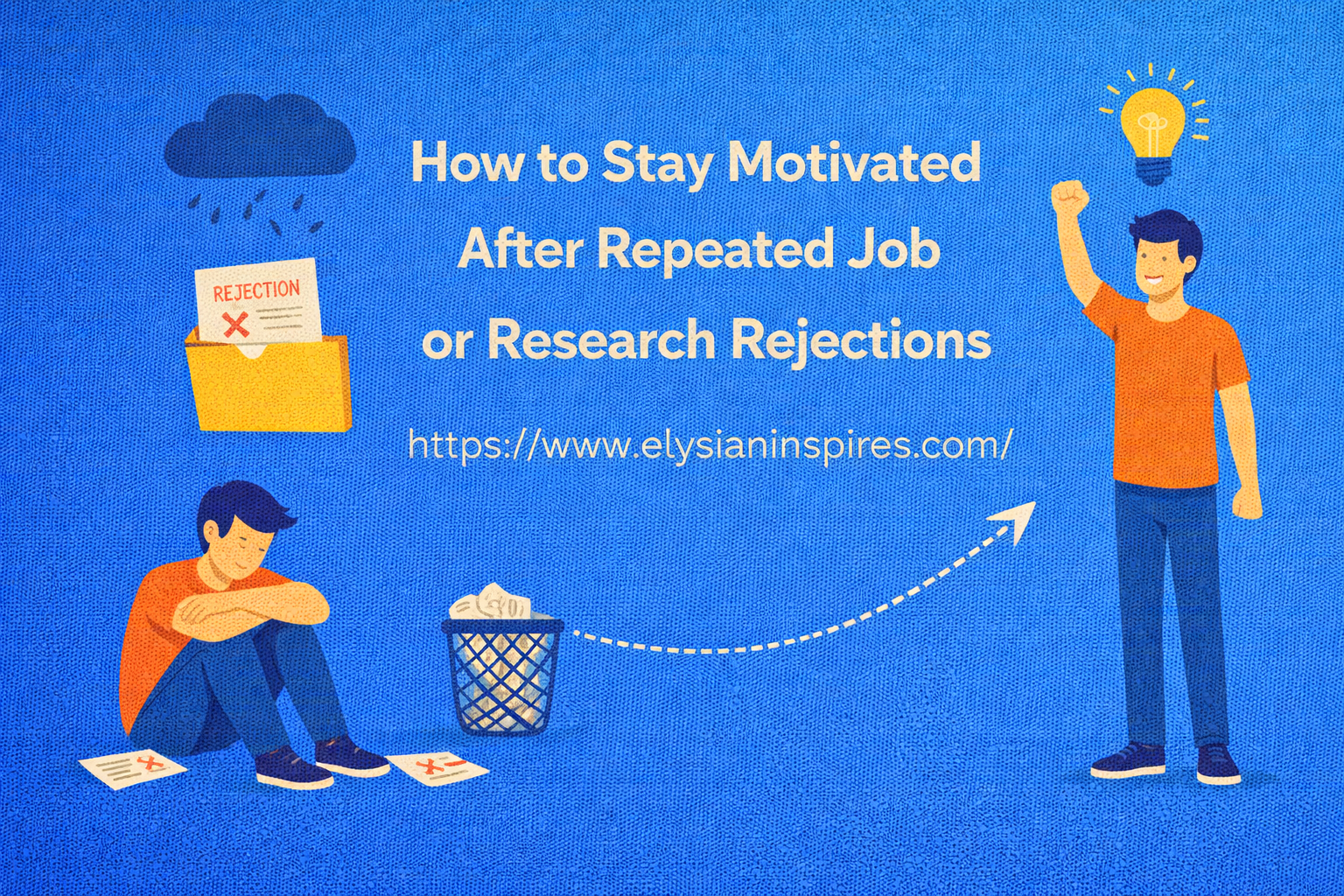
Staying motivated after repeated rejections means separating your self-worth from the outcome, learning one specific lesson from each “no,” and rebuilding momentum through small, controllable actions (applications, experiments, practice), not hope alone. If you are searching for How to Stay Motivated After Repeated Job or Research Rejections, the fastest path is to treat rejections as data, tighten your strategy (resume, interview, or research pitch), and protect your energy with a simple weekly routine. Elysian Inspires
Quick reset you can use today (save this):
- Name the rejection type (resume screen-out, interview, journal desk reject, reviewer reject, grant reject).
- Pick one fix for the next 7 days (not 10 fixes).
- Track process goals (hours, attempts, practice), not only outcomes.
- Get one outside review (mentor, peer, or counsellor) before you send the next batch.
“Why do Job or Research Rejections feel so personal, even when I worked hard?”
Rejection triggers a threat response in the brain, so it can feel like your identity is being judged.
In reality, most Job or Research Rejections are multi-factor decisions: timing, budget, fit, internal candidates, topic priorities, or reviewer preferences.
If you remember one thing, remember this: rejection often means “not now, not this framing, not this match,” not “not you.”
A helpful reframe is from the growth mindset lens popularized by psychologist Carol Dweck: skill and outcomes improve with deliberate practice, not with “being perfect.”
“Is repeated rejection a sign I’m not good enough?”
Not necessarily.
Repeated rejection usually signals one of three fixable gaps:
- Signal gap (your resume, abstract, SOP, or proposal is not showing your best work clearly).
- Fit gap (you are applying to roles, labs, or journals that want a different profile).
- Proof gap (you need one more credible proof: project, publication, internship, portfolio, recommendation).
This is good news because each gap has a different solution.
Your motivation improves when your plan becomes specific.
“What should I do in the first 24 hours after a rejection email?”
Do two things only: regulate, then review.
Regulate (10 minutes): walk, breathe slowly, or talk to a safe person.
Review (15 minutes): write one sentence: “This was a rejection of my application, not of me.”
Then stop.
If you try to “fix your whole life” on rejection day, you will burn out.
“How can I turn rejection into a repeatable system, not an emotional rollercoaster?”
Build a small loop: Reset, Improve, Repeat.
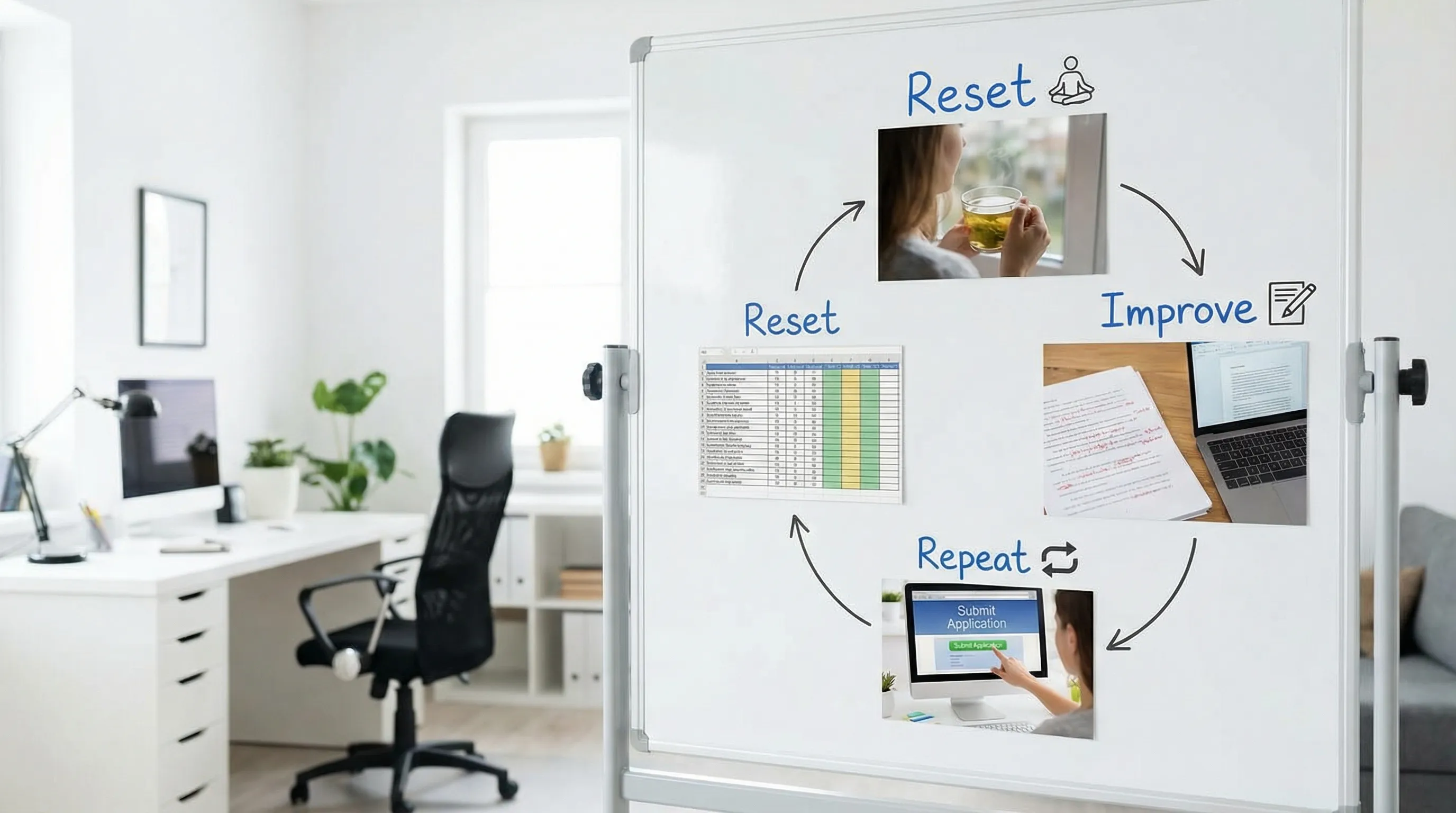
“What should I track each week so my motivation stays stable?”
Track what you can control.
Here is a simple tracker that works for both job seekers and researchers.
| Area | Process metric (weekly) | What it tells you | What to change if it’s weak |
|---|---|---|---|
| Output | Applications or submissions sent | Consistency | Reduce perfectionism, batch tasks |
| Quality | Tailored versions created | Targeting | Improve fit and keywords |
| Proof | Portfolio items or experiments added | Credibility | Build one proof-of-work asset |
| Feedback | Reviews from a human (mentor/peer) | Blind spots | Ask for critique, not compliments |
| Recovery | Sleep, movement, off-screen time | Sustainability | Add rest, shorten daily targets |
When your motivation dips, this table helps you diagnose without spiralling.
“How do I know whether my resume is the problem or my interview is the problem?”
Use a simple diagnostic rule.
If you are getting almost no calls, it is usually a resume, targeting, or keyword issue.
If you get interviews but no offers, it is usually a story, confidence, structure, or role-match issue.
If you are in research and you get desk rejects quickly, it is often a scope, novelty, or fit issue.
If reviewer comments repeat the same critique, it is often a framing and evidence issue.
This is where career planning becomes practical, it tells you what to fix first.
“What are the most common hidden reasons for job rejection (that nobody tells you)?”
These are common patterns we see in counselling, and they are fixable.
“Are my applications too generic?”
Often, yes.
A resume that looks like “one document for all jobs” reads as high risk to recruiters.
Use resume writing tips that improve clarity fast: align your summary to the job title, mirror core skills, and show outcomes.
If you want a step-by-step framework, ELYSIAN INSPIRES has a detailed guide on resume writing tips.
“Could ATS be rejecting my resume?”
Sometimes.
Common ATS mistakes are unusual formatting, missing keywords, and vague role titles.
A quick fix is to keep your layout clean, use standard headings, and add role-specific keywords naturally.
“Is my ‘experience’ not translating into impact?”
This is a big one.
Replace responsibilities with outcomes.
Instead of “Handled social media,” say “Grew Instagram engagement by X% through weekly content experiments.”
If you do not have numbers, use scope (users, frequency, deadlines) as proof.
“What are the most common reasons for research rejection (papers, grants, PhD applications)?”
Research selection is competitive, and the bar is often about fit and clarity, not just intelligence.
“Is my work not novel enough?”
Sometimes the novelty is there, but the framing hides it.
A practical test: can you explain your contribution in one sentence to a smart non-expert?
If not, rewrite your abstract or proposal around the contribution, not the process.
“Do I need to change the journal or lab I’m targeting?”
Possibly.
Many early-career researchers lose months aiming at mismatched scope.
A targeted shortlist, with two stretch options and a few strong-fit options, is more sustainable.
If you are exploring stable paths after a PhD, this ELYSIAN INSPIRES resource on government and research jobs available after PhD in India can help you widen your options without panic.
“What resume writing tips help after repeated rejections, without rewriting everything?”
Here are edits that give high returns quickly.
“What should I change first?”
Start with the top third.
Recruiters spend seconds on the first scan.
Update these three parts:
- Headline: match the target role (for example, “Data Analyst, SQL + Power BI”).
- Summary: 2 lines with your strongest skills and proof.
- Top projects: 2 to 3 bullets that show outcomes.
These resume writing tips usually improve interview calls faster than rearranging your whole resume.
“Should I include a ‘rejections’ gap or a break?”
You do not list “rejections,” you list growth.
Add a small “Projects” or “Learning” section with proof, such as a GitHub link, a case study, or a certification project.
“Which interview tips help when I’ve been rejected multiple times?”
The goal is to reduce perceived risk.
Even strong candidates get rejected when their answers feel generic, unstructured, or not role-matched.
“What should I do in the first 90 seconds of an interview?”
Give a role-match pitch.
Use this template:
“I’m a [role] with [X strength]. In my last project, I achieved [proof]. I’m excited about this role because [role-specific reason].”
This is one of the simplest interview tips that improves first impressions.
“How do I answer ‘Tell me about yourself’ without rambling?”
Use a three-part structure: Present, Past, Proof.
Present: what you are now.
Past: what shaped you.
Proof: one achievement aligned to the job.
For more practical interview tips, revisit ELYSIAN INSPIRES’ job interview tips page and practice with a timer.
“How many mock interviews should I do?”
Do fewer, but higher quality.
Two good mocks with honest feedback often beat ten casual practice chats.
If anxiety is your blocker, pairing mock practice with coaching is usually faster.
“How should I do career planning so motivation doesn’t depend on results?”
Motivation becomes stable when you know your direction and your next small step.
Here is a simple way to do career planning without overthinking.
“What is a realistic 4-week plan after repeated rejections?”
Think in weeks, not months.
Week 1: diagnose (resume vs interview vs fit).
Week 2: upgrade one proof (project, publication plan, skill).
Week 3: targeted outreach (alumni, labs, referrals).
Week 4: apply in batches, review outcomes, adjust.
This is career planning as an experiment, not as a life sentence.
“Should I apply broadly or narrowly?”
Both have trade-offs.
| Strategy | Pros | Cons | Best for |
|---|---|---|---|
| Broad applications | More chances, faster feedback | Low customization, higher burnout | Early exploration, urgent timelines |
| Narrow targeted | Higher fit, better story | Slower volume, needs clarity | Mid-career, niche roles, research tracks |
A blended approach often works best: a small targeted list, plus a limited broad list.
“How can I stay motivated when everyone else seems to be succeeding?”
Compare process, not outcomes.
You rarely see the full story behind someone’s offer letter or acceptance email.
Try this instead: keep a “wins log” with micro-wins.
A micro-win can be “I rewrote my abstract,” “I asked for feedback,” or “I did one mock interview.”
Motivation grows when your brain sees progress it can trust.
“When should I take a break, pivot, or get professional help?”
Take a break when your body starts saying “no,” such as poor sleep, constant irritability, or dread.
Pivot when your data is consistent, for example, months of applying with no movement and no new proof added.
Get help when you feel stuck in the same loop, even after changes.
This is especially true for repeated Job or Research Rejections that start affecting confidence, relationships, or mental health.
If your emotional wellbeing is suffering, consider speaking to a qualified mental health professional.
“How can career counselling Chennai help if I’m stuck after rejections?”
Good counselling reduces confusion and shortens the trial-and-error cycle.
With ELYSIAN INSPIRES, support typically focuses on clarity and execution: strengths assessment, skill and goal identification, profile building, and practical preparation.
If you are considering career counselling Chennai, start with a targeted session that answers: “What is my best-fit direction, and what should I do for the next 30 days?”
You can explore ELYSIAN INSPIRES’ Professional Career Counselling in Chennai to understand how structured guidance works.
“What are the pros and cons of counselling vs doing it alone?”
Here is a practical comparison.
| Option | Pros | Cons | Who it suits |
|---|---|---|---|
| Self-guided | Low cost, flexible | Blind spots, slower iteration | Highly self-directed candidates |
| Mentor/peer feedback | Industry insight, credibility | Not always available, can be biased | People with strong networks |
| Career counsellor | Structured plan, assessments, accountability | Requires commitment and openness | People facing repeated rejections |
If you are repeatedly stuck, career counselling chennai can be the difference between random effort and a measurable plan.
“Can you give an example of bouncing back after repeated job or research rejections?”
Yes.
“Example 1: Job search (fresher or early career)”
Riya applied to 40 roles and got zero calls.
Instead of applying more, she used resume writing tips to rewrite her top section, added one proof project, and applied to 12 targeted roles.
She got three interview calls, then used structured interview tips (role-match pitch, STAR stories) to convert one offer.
“Example 2: Research applications”
Arjun’s paper was rejected twice.
He mapped reviewer feedback into three themes, rewrote the contribution statement, and changed the target journal to a better scope match.
He also expanded his plan B using broader options in his career planning, including research roles outside academia.
“What are the key takeaways if I want motivation that lasts?”
Motivation becomes durable when your plan is measurable, and your identity is protected.
- Treat Job or Research Rejections as information, not a verdict.
- Fix the right layer first (signal, fit, or proof).
- Use repeatable resume writing tips and practice high-impact interview tips.
- Keep career planning weekly and realistic.
- If you need a structured push, career counselling Chennai can speed up clarity and execution.
Frequently Asked Questions
How do I stay motivated after repeated job or research rejections?
How can I tell if my resume is causing rejections?
What should I do immediately after a rejection?
What are the best interview tips after multiple rejections?
How do I handle repeated research paper rejections?
How can career counselling in Chennai help after repeated rejections?
