


Is DMIT Accurate Enough to Guide Career Choices for Teenagers?
DMIT is not accurate enough to be the only basis for a teenager’s career choice. At best, it can be an exploratory input that highlights possible learning preferences and strengths, but career decisions should be validated using multiple tools (aptitude, interests, personality, academic performance, exposure, and counselling). DMIT Test !
Key takeaways for parents and teens
- Use DMIT as a starting conversation, not a final verdict.
- Accuracy in career guidance comes from triangulation (more than one method agreeing).
- The most reliable outcomes happen when assessments are followed by real-world trials (projects, internships, clubs, skill based courses).
- For stream and college decisions, pair tests with counselling for students after 12th so options, admissions, and career paths align.
What exactly is DMIT, and what does “accurate” even mean here?
DMIT (Dermatoglyphics Multiple Intelligence Test) is a fingerprint-based assessment that claims to map innate tendencies (often discussed as intelligences, learning style, or behaivour traits).
When families ask “accurate,” they usually mean one of these:
- Consistency: Does it give similar results over time?
- Predictive value: Does it correctly predict which subjects or careers the teen will enjoy and succeed in?
- Usefulness: Does it help reduce confusion and narrow options responsibly?
A useful career tool must do more than sound relevant. It should help a teen make better decisions and avoid costly mistakes.
Is DMIT Accurate Enough to Guide Career Choices for Teenagers?
Is DMIT Accurate Enough to Guide Career Choices for Teenagers?
It can be directionally helpful for self-awareness, but it is not a stand-alone, scientifically definitive career predictor.
Teenagers are still developing in interests, identity, motivation, and exposure. Even if a report feels “spot on,” it may be describing broad traits that fit many people.
A safer way to use the result is:
- Treat it as a hypothesis (possible strengths)
- Validate it with evidence (marks trends, projects, behaviour, feedback from teachers)
- Convert it into actions (subject choices, portfolio, skill based courses, internships)
Why do some parents feel DMIT is “very accurate”?
Because DMIT reports often use strengths-based language that feels personal.
If a teen is already showing a pattern (for example, strong visual learning, good rhythm, or people skills), any tool that mirrors that can feel highly accurate.
It can also be accurate in a limited sense when:
- The teen already has clear interests
- The counsellor interprets the report ethically and practically
- The family uses it to explore options rather than to label the child
What are the biggest limitations you should know before trusting DMIT?
This is where many families need clarity.
Does DMIT have the same research backing as standard psychometrics?
Not in the same way. Traditional psychometric tests are usually built on well-established measurement principles (reliability, validity, norms, standardization).
DMIT’s career-prediction claims are not universally supported by large, transparent, peer-reviewed evidence in the way mainstream aptitude and interest inventories are.
A practical way to think about it:
- DMIT may help with insight
- Psychometrics are generally stronger for structured measurement
- Counselling and exposure are essential for real-life fit
Can DMIT “lock” a teen into one career?
It should not.
Career choice is not like matching a blood group to a job. It is a combination of:
- strengths
- interests
- values
- opportunities
- effort and skill-building
When any assessment is used like a final stamp, it can harm confidence and curiosity.
Can it miss late bloomers or motivated learners?
Yes.
Many teens develop new interests after exposure to better teachers, peer groups, competitions, or the right learning environment. A tool that over-focuses on “innate” traits can underplay growth.
How does DMIT compare with psychometric tests and Multiple Intelligence Analysis?
If you want a more grounded decision, compare tools by what they measure and how you will use the output.
| Tool | What it usually helps with | Strengths | Cautions |
|---|---|---|---|
| DMIT | Self-awareness themes (as interpreted), discussion starter | Easy entry point for families, can reduce confusion | Should not be treated as a definitive predictor |
| Psychometric tests | Aptitude, interests, personality patterns | More structured measurement approach | Still needs interpretation and real-world validation |
| Multiple Intelligence Analysis | Broad intelligence profile across domains | Useful for mapping learning and activity fit | Not a “career guarantee”; needs action plan |
At ELYSIAN INSPIRES, families often pair DMIT conversations with Multiple Intelligence-based assessment and counselling for practical next steps. You can explore their approach to Multiple Intelligence Analysis.
If DMIT is limited, when is it still useful for teenagers?
DMIT can be helpful when it is used for career exploration, especially for teens who feel stuck.
Is it useful for Class 10 to Class 12 decision points?
Yes, as a conversation starter.
These years involve:
- stream selection
- entrance exam planning
- deciding between degree paths and skill based courses
For families navigating this stage, it helps to combine testing with structured guidance like Career Guidance for 12th std Students.
Is it useful for motivation and study strategy?
Sometimes.
Even when career prediction is uncertain, a teen can benefit if the discussion leads to:
- better study methods
- improved subject strategy
- healthier self-image
If academic pressure is high, support like Counselling for Exam Stress can also be part of the plan.
What does a responsible “DMIT + career counselling” process look like?
Think of the report as “data,” then turn it into proof.
Here is a simple, safer flow many counsellors use.
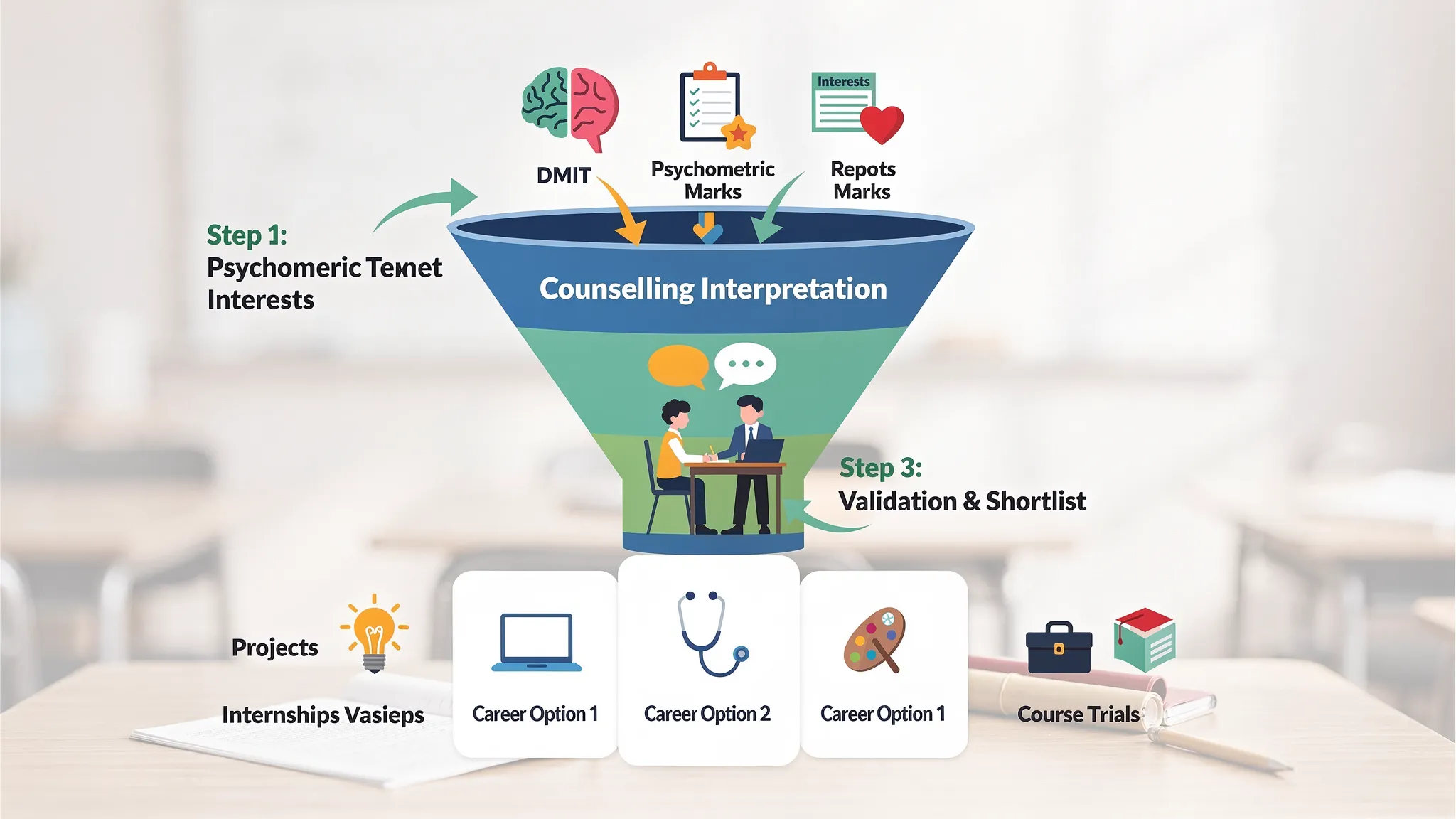
Step 1: Clarify what decision you are making
A DMIT report means nothing if the decision is unclear.
Examples of clear decisions:
- “Choose between Commerce with Maths vs Science (PCM).”
- “Pick 3 career clusters to explore in the next 60 days.”
- “Decide whether to do a degree route or skill based courses first.”
Step 2: Triangulate the result with at least two more evidence sources
Use a simple “2 out of 3” rule.
- Does the teen’s behaviour match the report?
- Do teachers’ observations match?
- Do psychometric or interest tests point in a similar direction?
If only the report points there, treat it as low confidence.
Step 3: Validate using small experiments (this is where clarity comes)
Validation is what makes career guidance real.
Try:
- a 2-week project (mini portfolio)
- a club or competition
- a short internship or job shadow
- a starter module from skill based courses to check genuine interest
Can DMIT help with “counselling for students after 12th” specifically?
Yes, but only if the output is translated into practical academic planning.
After 12th, the stakes are high because decisions involve:
- college selection
- entrance exams
- budget and location
- employability and higher studies
That is why many families benefit more from a counselling plan than from a single test.
If you are exploring structured guidance, see Professional Career Counselling in Chennai for how ELYSIAN INSPIRES supports decision-making.
What are the pros and cons of using DMIT for teenage career decisions?
A balanced view helps you avoid over-trust and under-use.
Pros
- Can reduce initial confusion by giving a starting framework
- Helps some teens talk about strengths without feeling judged
- Can support parent-teen communication when interpreted gently
Cons
- Can be over-sold as “100% accurate,” which is a red flag
- Risk of labelling: “You are only suited for X”
- Career fit depends heavily on environment, effort, mentoring, and opportunities
What are the red flags when someone promises “high accuracy”?
If you are screening providers (especially when searching for the best career counsellor in India), watch for how they speak about evidence and ethics.
Red flags include:
- Guaranteeing a fixed career outcome from one test
- Claiming the test is perfect for every teen
- Not asking about marks, interests, family context, or mental health
- Skipping counselling and giving only a report
A trustworthy counsellor will focus on decisions, next steps, and emotional safety, not just a report.
How do parents use DMIT without creating pressure?
Parents matter a lot in how results land emotionally.
What should you say to your teen after the report?
Use curiosity, not certainty.
Helpful phrases:
- “This suggests you may enjoy these tasks. Shall we try one this month?”
- “Let’s shortlist 3 options and test them through projects.”
- “This is one input. Your effort and interest still lead the decision.”
If parent-teen communication is tense, you may also like Tips for Parents of Teenagers.
Can you share examples of how teens can use DMIT results practically?
Yes. Here are realistic, safe examples.
Example 1: “My report says I’m strong in logical intelligence, so should I take Computer Science?”
Not automatically.
A better move is to test fit:
- do a beginner Python project
- build a small app or website
- try a 4 to 6 week module from skill based courses in coding
If the teen enjoys the process, then explore degree routes.
Example 2: “The report points to communication and people skills. Does that mean no Science?”
No.
People skills are valuable in medicine, research leadership, product management, law, teaching, HR, marketing, and entrepreneurship.
This is where counselling converts traits into multiple career clusters.
Example 3: “My teen dislikes theory but likes hands-on work. What now?”
This is where skill based courses can be powerful.
A counsellor can map hands-on preferences to paths like:
- UI/UX and digital design
- paramedical and allied health
- culinary, hospitality
- technician and vocational tracks
If you want a head start, ELYSIAN INSPIRES has a detailed guide on skill-based courses after 12th.
So what should you do if you already took DMIT and you are still confused?
That is common, and it does not mean the teen is “lost.”
A practical next step is to book a session where the counsellor:
- reviews the report alongside interests, marks, and goals
- shortlists 3 to 5 realistic pathways
- creates a 30 to 90 day plan (projects, exposure, entrance plan, skill based courses where relevant)
If you need flexible support, consider Best Online Career Counselling in India (useful if you are not in Chennai or prefer home-based sessions).
How does ELYSIAN INSPIRES support teen career decisions beyond a single test?
ELYSIAN INSPIRES provides personalized career and academic counselling in Chennai and online. Their work typically focuses on:
- identifying strengths and goals through structured assessments
- translating results into subject, stream, and career options
- supporting profile building and planning for higher studies
If your family is ready to move from “results” to “decisions,” start with Career Counselling in Chennai or directly use their career counselor contact number to book a slot.
Frequently Asked Questions
Is DMIT Accurate Enough to Guide Career Choices for Teenagers?
Can DMIT predict the right stream after Class 10 or 12?
What is better than DMIT for career guidance?
Should parents follow DMIT results strictly?
Can DMIT help with counselling for students after 12th?
Are skill based courses a good option if a teen dislikes academics?
Is online counselling for career guidance effective for teenagers?
How do I choose the best career counsellor in India for my child?
