


What Is the Next Career Move After Becoming a CA?
If you’re asking “What Is the Next Career Move After Becoming a CA?” the simplest answer is this: your next move is the role (or specialization) where your CA skills create maximum impact, learning, and long-term growth, based on your interests, strengths, and lifestyle goals. Many CAs grow fastest when they “skill-stack” finance expertise with one high-demand domain like analytics, risk, valuation, or ESG.
I have become a CA. What should I do next?
Start by choosing one of three clear directions. Each direction is a “good” choice, if it matches your strengths.
- Deepen your CA track (audit, tax, compliance, internal controls)
- Move closer to business decisions (FP&A, corporate finance, strategy, transaction advisory)
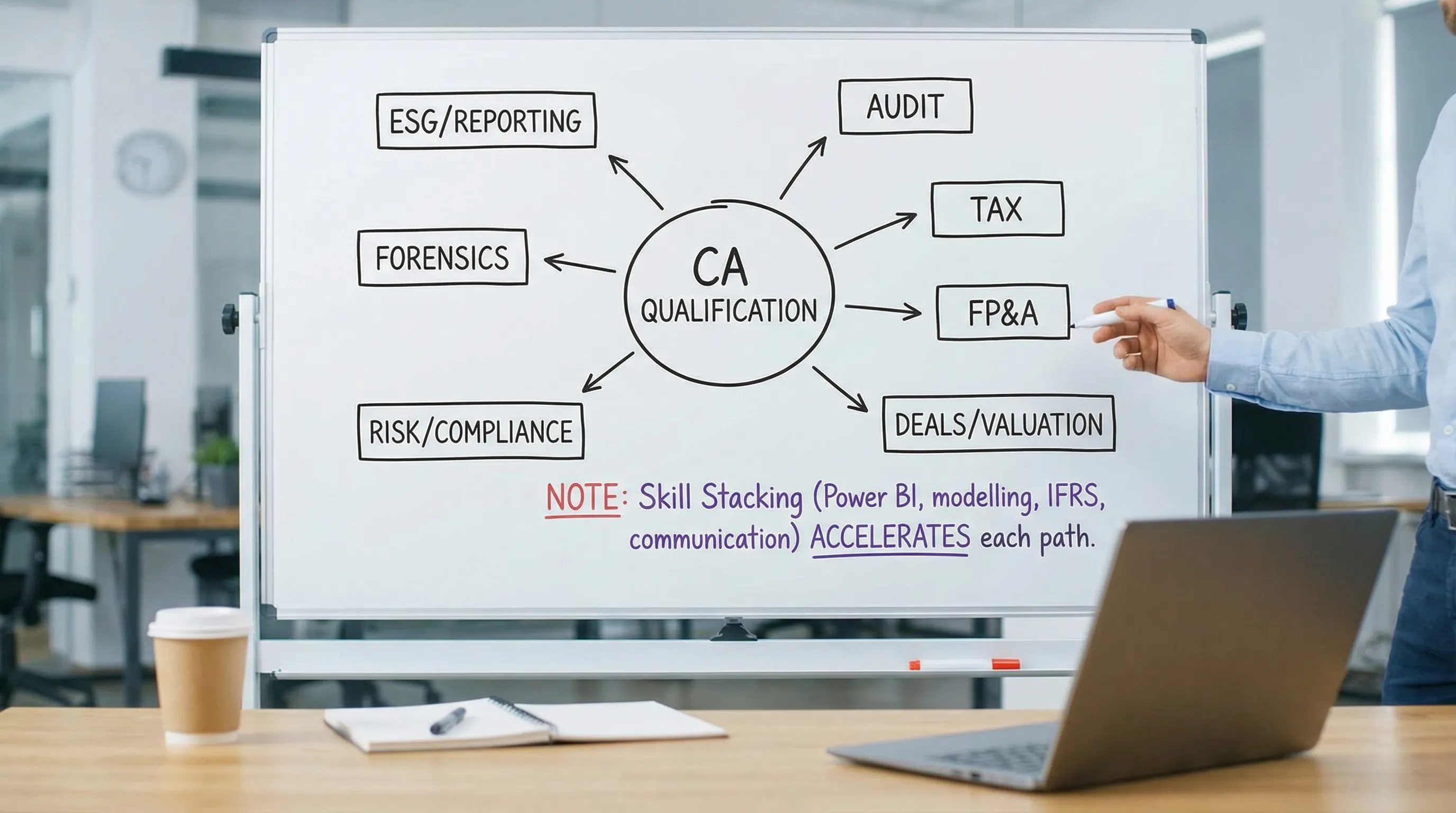
- Pivot into a new domain using CA as a base (fintech, analytics, risk, forensics, ESG)
If you feel stuck, it’s not a capability issue. It’s usually a “positioning” issue.
A helpful check is: do you want to be known for accuracy and compliance, business growth and decisions, or specialized expertise?
What are the most common career paths after CA in 2026?
Here are realistic, high-signal paths where CAs typically build strong careers.
Should I choose Corporate Finance or Audit after CA?
Corporate Finance is closer to business outcomes like budgeting, profitability, and investment decisions.
Audit builds deep strength in controls, risk identification, governance, and regulatory discipline.
Quick comparison (use this to decide faster):
| Path | Best for people who enjoy | Typical work style | Biggest advantage | Common challenge |
|---|---|---|---|---|
| Audit (Stat/Internal) | Processes, controls, risk spotting | Structured, periodic peaks | Strong foundation, respected credibility | Can feel repetitive without specialization |
| Tax (Direct/Indirect) | Law, interpretation, detail | Deadline-driven | Clear expertise, high demand | Frequent updates, high compliance pressure |
| FP&A | Forecasting, business partnering | Monthly cycles | Visibility with leadership | Requires strong stakeholder skills |
| Transaction Advisory | Deals, valuation, due diligence | Project-based | Fast learning, strong brand value | Intense timelines |
| Risk/Compliance | Governance, frameworks | Ongoing | Stable growth in regulated industries | Needs constant policy alignment |
What roles give faster growth for CAs?
Fast growth usually comes from roles that sit near “money decisions” or “risk decisions”.
- FP&A and business finance
- Deal advisory (due diligence, valuation support)
- Forensic accounting and investigation
- Enterprise risk, internal controls, and compliance leadership
Growth becomes much faster when you build one “signature skill” beyond accounting.
What specialisations can I build after becoming a CA?
If your question is “What Is the Next Career Move After Becoming a CA?” the word to focus on is “specialisation”. Generalists get jobs. Specialists get pulled into better opportunities.
Is GST specialisation still worth it?
Yes, but only if you treat it as a true expertise track.
Pros
- High relevance across sectors
- Strong consulting and practice potential
Cons
- Continuous updates and compliance pressure
- Growth depends on client base or domain depth
If you like law-meets-numbers work, GST can be a long-term career.
Should I move into International Tax or IFRS?
This is a strong choice if you want multinational exposure and global mobility.
Pros
- Works well with MNCs and global reporting
- Good long-term relevance
Cons
- Learning curve, standards-heavy work
- Needs continuous upskilling
For structured learning, you can also explore ICAI’s post-qualification learning routes on the official ICAI website.
What about Forensic Audit and Fraud Investigation?
Forensic is a great option for CAs who like problem-solving and investigative work.
You’ll typically need stronger skills in documentation, interviewing, data analysis, and report-writing.
Can a CA switch into finance roles like Investment Banking or Equity Research?
Yes, but you need proof-of-work and the right positioning.
What makes the switch easier?
Three things usually make the difference.
- Strong financial modelling fundamentals
- Valuation understanding (DCF, comparables)
- A portfolio of case studies (even self-built)
What are the pros and cons of Investment Banking for CAs?
Pros
- Strong exposure to deals and decision-making
- High learning and brand value
Cons
- Intense hours and deadline pressure
- Entry depends heavily on profile and networking
If you want this path, your resume must show deal thinking, not just “qualified CA”. ELYSIAN INSPIRES can support profile clarity and CV direction through its resume guidance resources.
Which skill based courses should a CA consider to level up?
A CA degree is powerful, but your next jump often comes from skill based courses that add modern capability.
Which skill based courses have the best ROI for CAs?
Choose based on the career track you want.
- Data and reporting: Advanced Excel, Power BI, basic SQL
- Finance track: Financial modelling, valuation, corporate finance
- Systems track: ERP basics (finance modules), process automation concepts
- Risk track: Internal controls, ISO basics, governance frameworks
- New-age track: ESG fundamentals, sustainability reporting basics
Shortlisting matters. Random courses create noise, not growth.
How do I choose the right courses without wasting money?
Use a 3-part filter.
Role fit: Does this course directly support the roles you’re applying for?
Proof: Will you produce something visible (project, case study, portfolio, certification)?
Market signal: Do job descriptions repeatedly ask for this skill?
If you want help doing this systematically, online counselling for career guidance can help you pick courses that match your target role, timeline, and learning style.
Should I do an MBA after CA?
MBA is helpful for certain goals, but it is not automatically the “next step”.
When does an MBA make sense after CA?
It makes sense when you want a structured pivot into leadership tracks like.
- Strategy
- Product, business management
- Consulting
- General management
When should I skip the MBA (at least for now)?
If you can reach your target role through skill stacking, switching companies, or a focused specialization, an MBA may not be necessary immediately.
Pros of MBA after CA
- Strong network and role change potential
- Broader business exposure
Cons of MBA after CA
- High cost and opportunity cost
- Not always required for finance leadership roles
A practical approach is to decide based on your “next 24 months”, not your next 20 years.
What if I want to start my own practice or consulting after becoming a CA?
This is a strong path, especially if you combine a niche with a clear client segment.
What niches work well for CA practice today?
Some sustainable niches include.
- GST and compliance with advisory
- Startup finance, bookkeeping systems, CFO support
- Internal audit for SMEs
- Due diligence support services
What are the real pros and cons of CA practice?
Pros
- Independence and compounding client relationships
- Ability to build a niche brand
Cons
- Client acquisition takes time
- Cash flow can be uneven early on
If you choose practice, communication and positioning become as important as technical knowledge.
How do I decide my next career move if I’m confused?
Confusion is common right after you become a CA, because the option set is huge.
Here is a simple decision framework used in counselling.
What do I enjoy doing daily?
Try to answer with work tasks, not job titles.
Do you enjoy.
- Reviewing and improving systems?
- Explaining complex rules?
- Building models and forecasts?
- Investigating anomalies?
- Advising founders or leaders?
What do I want my profile to be known for?
A helpful “positioning” question is.
Do I want to be known as a.
- Compliance expert
- Business finance partner
- Deal and valuation professional
- Risk and governance specialist
- Finance-tech and analytics professional
What is my risk tolerance right now?
Your next step should match your current reality.
- If you need stability, a strong corporate role can be best.
- If you can take risk, niche practice or a pivot can work.
This is exactly where career counselling for professionals becomes useful, because it turns “options” into a decision and a timeline.
How can ELYSIAN INSPIRES help CAs plan the next move?
If your real question is “What Is the Next Career Move After Becoming a CA?” you don’t need generic advice, you need a personalized map.
At ELYSIAN INSPIRES, we typically focus on clarity, fit, and execution.
What happens in a counselling-led career plan?
The goal is to reduce guesswork and increase alignment.
- Identify strengths and preferences using structured tools
- Match those strengths to realistic CA-adjacent roles
- Build an action plan (skills, projects, profile, applications)
You can explore career counselling through our Professional Career Counselling in Chennai page.
If you prefer assessments, you can also read about our approach to psychometric tests and Multiple Intelligence Analysis, which support career clarity when interpreted correctly.
Why choose online sessions for CA career planning?
Many CAs prefer privacy and flexibility, especially while working.
Benefits of online counselling for career guidance
- Works around busy audit and closure seasons
- Faster iteration (plan, act, review)
- Convenient if you are outside Chennai
You can also see how our online career counselling after graduation format works, many CAs use it because the decision patterns are similar.
Key takeaways (quick recap)
- The best next step after CA is usually a specialization plus skill stacking, not a random job switch.
- Choose between three directions: deepen CA track, move closer to business, or pivot into a new domain.
- Use skill based courses only when they create proof and match job descriptions.
- If you’re still unsure, career counselling for professionals can convert confusion into a plan.
Ready to plan your next step with clarity?
If you’re serious about choosing the right direction after you become a CA, don’t rely on random opinions. Get a personalised plan with ELYSIAN INSPIRES.
- Talk to our team via the career counselor contact number.
- Or explore Professional Career Counselling in Chennai to book a session and build a focused roadmap.
Frequently Asked Questions
What Is the Next Career Move After Becoming a CA?
Which skill based courses are best after I become a CA?
Is it better to do an MBA after CA or gain work experience first?
Can career counselling for professionals help CAs who feel stuck?
Do you offer online counselling for career guidance for CAs in India?
