


What Steps Should I Take to Raise My Grades in Academics.

Want a quick, reliable answer? To raise your grades fast, diagnose where marks are leaking, set a realistic target, switch to proven study methods (active recall and spaced practice), plan a weekly timetable, practice exam‑style questions, fix sleep and distractions, get feedback from teachers, and track progress every week. If you are in Class 12, align study time with your target courses after 12th so every hour moves you closer to college choices that fit you.
- Key takeaways:
- Test yourself more than you reread, and space your revisions across weeks.
- Practice past papers under time limits, then correct your mistakes immediately.
- Sleep 8 hours, cut multitasking, and plan short, focused sessions.
- Use teacher feedback, accountability, and if needed, exam stress counselling.
- If you are unsure about direction, career guidance after 12th clarifies what to study and why.
“A Chennai student at a tidy desk with a weekly study timetable, flashcards, a closed laptop, a wall calendar, and a water bottle. Sunlight falls on the table, the phone is kept face down to avoid distractions.”
What steps should I take to raise my grades in academics, starting this week?
Here is a simple 8‑step plan you can start today.
- Diagnose quickly
- Scan your last two tests and mark where you lost marks: concepts, careless errors, or time mismanagement.
- List 3 topics per subject where improvement gives the fastest score lift.
- Set a concrete target
- Example: Physics 62 to 75 in 6 weeks. Translate that into 3 topics per week and 4 timed tests.
- Switch to evidence‑based techniques
- Active recall: close the book, write or say answers from memory.
- Spaced practice: revisit topics across days and weeks rather than cramming.
- Interleaving: mix question types in a single session to improve transfer.
- Plan your week in blocks
- 50 to 90 minute focus blocks, 10 minute breaks.
- Rotate 2 to 3 subjects daily, heavier blocks for your weak areas.
- Do exam‑style practice
- Past papers and mock tests under time limits, then immediate error analysis.
- Fix sleep and focus
- Aim for 8 hours, put your phone away during sessions, study at the same time each day.
- Get feedback and accountability
- Ask a teacher to review two of your answers every week.
- Study partner or counsellor check‑in to keep you consistent.
- Track progress visibly
- Keep a one‑page progress sheet: topics done, mock scores, error types, next steps.
Why this works: A major 2013 review found that practice testing and spaced practice consistently outperform popular methods like highlighting and rereading for long‑term learning. See Dunlosky J Psychological Science in the Public Interest, 2013.
Which study techniques actually boost marks, and which waste time?
| Technique | What it looks like | Effect on grades | Best use |
|---|---|---|---|
| Active recall | Answer from memory, flashcards, closed‑book summaries | High | Daily practice, quick quizzes |
| Spaced practice | Review across days and weeks | High | Timetable your revisions |
| Interleaving | Mix topics and question types | Medium to high | Problem‑solving subjects |
| Elaborative examples | Explain “why” with your own example | Medium | Theory, long answers |
| Highlighting only | Coloring text, no testing | Low | Use only to locate key points |
| Rereading only | Reading same chapter repeatedly | Low | Pair with recall or questions |
- Evidence snapshot: Dunlosky J. rate practice testing and spacing as high utility. The spacing effect is robust across ages and subjects.
How do I plan my week when I have multiple subjects?
Try this simple split for board or semester prep.
- Monday to Friday: 3 focus blocks daily, 2 core subjects and 1 rotating subject.
- Saturday: full mock test in your hardest subject, then error analysis.
- Sunday: light review, flashcards, and planning for next week.
Example block sequence for a science student: Physics problems, English writing practice, Chemistry numericals. For commerce: Accountancy ledger problems, Business Studies case answers, Economics graphs.
Tip: Use the Cornell note method to turn lectures into testable cues.
I have only 30 days. What is the fastest plan that still works?
- Week 1: Identify top 10 weak topics. Do daily 2 blocks of active recall plus 1 block of mixed questions.
- Week 2: Start alternate‑day past paper sections. Track speed and accuracy.
- Week 3: Full‑length mocks for two subjects, one day apart. Tighten presentation and step‑wise working.
- Week 4: Focus on error patterns, formula sheets, flashcards, and two final timed mocks.
If exam anxiety is rising, combine this with short breathing resets and, if needed, exam stress counselling. ELYSIAN INSPIRES offers exam stress support and personalized academic counselling in Chennai and online.
Read next: How to study smartly and score more marks?
Do sleep and exercise really affect grades?
Yes. Sleep is when memory consolidates. Teens typically need 8 to 10 hours per night, and adults need 7 or more (CDC guidance).
- Quick wins:
- Keep a fixed sleep window, avoid screens 60 minutes before bed.
- Light exercise or a brisk walk daily improves focus and mood.
Should I join tuition or stick to self‑study?
- Tuition can help when:
- You need structured explanations, or your school schedule leaves gaps.
- You want regular testing and expert feedback.
- Self‑study can work when:
- You already have notes, past papers, and a strong routine.
- You are comfortable with active recall and tracking your own progress.
- Hybrid approach: Use tuition for the toughest subjects, and self‑study for the rest.
Pros of tuition: mentorship, doubt‑clearing, structured testing. Cons: time cost, pace may not fit you, risk of passive learning if you do not practice independently.
How do I stop procrastinating and manage exam stress?
- Reduce friction: keep books and stationery ready, study at the same place and time.
- Timebox tasks: promise yourself 25 minutes of focus, then a 5‑minute break.
- Start with the smallest possible action, for example write one definition, solve one question.
- Use a worry pad: write concerns, schedule a time to address them after study.
If stress is affecting sleep or daily functioning, get help early. Try our Looking beyond exam stress and anxiety guide and consider a personalized session with ELYSIAN INSPIRES.
Will better grades really change my options for courses after 12th?
Absolutely. Strong board scores plus targeted entrance prep widen your choice of colleges and specializations. If you are unsure which program fits you, combine grade improvement with career clarity.
- Explore next:
If you are searching “What Steps Should I Take to Raise My Grades in Academics” because you want better courses after 12th, pair this study plan with expert guidance so you prepare for the right entrance tests and portfolios.
How can career guidance after 12th improve my academic focus now?
Purpose creates energy. When you know the degree and career you are working toward, it is easier to prioritize subjects, pick the right projects, and say no to distractions.
- What we do at ELYSIAN INSPIRES, Chennai:
- Multiple Intelligence‑based assessment to map your natural strengths.
- Personalized counselling sessions to choose suitable degrees.
- Guidance for higher studies, profile building, and CV writing.
- Exam stress counselling if pressure is getting in the way of performance.
Start here: How Our Career Counselling Programs Help Students Choose the Right Degree. We also offer online counselling for career guidance so you can get help from anywhere.
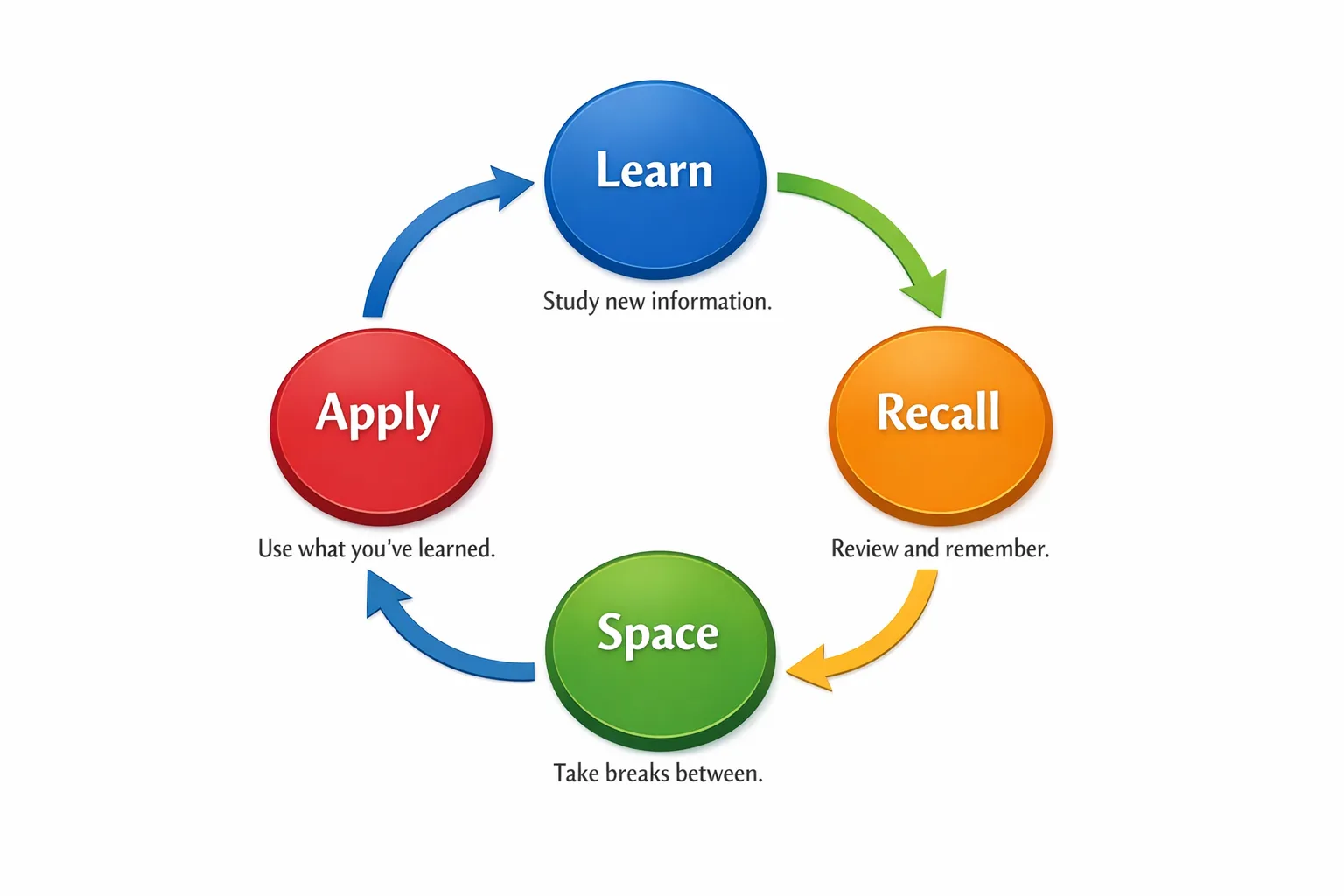
What does a good daily study block look like?
- Warm‑up, 3 minutes: quick recall from yesterday, 5 flashcards.
- Learn, 25 to 40 minutes: focused concept or problem type.
- Recall, 10 minutes: close the book, answer from memory.
- Apply, 15 minutes: 3 to 5 exam‑style questions.
- Review, 5 minutes: note errors and next steps in your planner.
How do I track progress to make sure this is working?
- Weekly scorecard:
- Mock scores per subject and time taken per section.
- Top 3 error types, for example missed formula, skipped step, misread question.
- Actions for next week, for example 30 minutes of formula drills daily.
- Monthly check:
- Compare first and latest mocks, note improvements by topic.
- Remove methods that are not working, replace them with those that do.
Is there a quick example of the entire plan in action?
- Day 1, choose three weak topics per subject.
- Day 2 to 5, daily recall and mixed questions across subjects.
- Day 6, full mock in your toughest subject, error analysis.
- Day 7, rest and light review, plan the next week.
Repeat for four weeks. Most students see early gains just by replacing rereading with recall plus spacing. If you want support, book a personalized academic counselling session with ELYSIAN INSPIRES in Chennai or online to tailor the plan to your board, subjects, and entrance goals.
Learn more about stream and course choices that match your strengths: Streams Are Not Destinies.
How does this align with Google’s AI Overview style?
- Direct, concise answer in the opening lines.
- Clear steps and short paragraphs for fast scanning.
- Q and A structure that maps to real student queries.
- Evidence and reputable references for E‑E‑A‑T.
- Internal links for deeper, Chennai‑specific guidance.
Quick action checklist you can print
- Pick 3 weak topics per subject, write them at the top of your planner.
- Create 3 daily focus blocks, phone away, books ready.
- Replace rereading with recall questions and spaced reviews.
- Practice past papers twice a week under time limits.
- Sleep 8 hours, exercise lightly, hydrate.
- Get feedback weekly from a teacher or counsellor.
- Track mock scores and error types on one page.
If you are wondering, “What Steps Should I Take to Raise My Grades in Academics,” start with these, then add career clarity so your study time and your courses after 12th work in the same direction.
Ready for personalized help? ELYSIAN INSPIRES provides academic and career counselling in Chennai with online appointment booking. We use scientific assessments, practical study plans, and one‑to‑one guidance to help you study smarter and choose the right path after 12th. Book your slot at Elysian Inspires.
References for deeper reading
- Dunlosky J (2013). Improving Students’ Learning with Effective Learning Techniques, Psychological Science in the Public Interest. High‑utility reviews of testing and spacing.
- American Psychological Association overview of the spacing effect. Why spacing beats cramming.
- CDC Sleep Guidance. How much sleep you need.
- Cornell Learning Strategies Center. Cornell Note‑Taking Method.
Frequently Asked Questions
What steps should I take to raise my grades in academics quickly?
How many hours should a Class 12 student study daily?
Which is better for memory, rereading or testing myself?
How soon can I see an improvement in marks?
Can stress counselling help with exam performance?
How does career guidance after 12th relate to better grades now?
Do you offer online counselling for career guidance?
